Solana staking lets you earn rewards by putting your SOL to work. But how does it actually work, what are the risks, and is it worth it? Here’s what you need to know before you start.
Key Takeaways
- Staking puts your SOL to work
You delegate your SOL to a validator to help secure the network and earn rewards in return. - You keep ownership, but your SOL is temporarily locked
Your funds stay in your wallet, but unstaking takes a few days before they’re fully available again. - Rewards come from the network itself
Earnings are generated through protocol-level inflation and fees, not from lending or third parties. - Returns are steady, not guaranteed
APY typically sits in a moderate range and varies based on validator performance and network conditions. - Risk is low, but not zero
The main risks are price volatility, validator performance, and the unstaking delay – all manageable with the right setup.
Staking is one of the core features of the Solana network. Instead of leaving your SOL idle, you can use it to help secure the network and earn rewards in return. According to Staking Rewards, about 68% of SOL’s circulating supply is currently staked.
But how exactly does staking work? Are you locking your crypto? Is it risky? Where do the rewards come from?
In this guide, we’ll break down what Solana staking is, how it works, what you earn, and how to get started safely.
What Is Solana Staking?
Staking is the process of locking up your SOL to help support and secure the Solana network, and earning rewards in return.
Instead of keeping your SOL idle in your wallet, you can delegate it to a validator. Validators are the participants who process transactions and keep the blockchain running.
By staking your SOL, you’re supporting those validators.
In return, you receive rewards over time.
If you’re completely new to the concept, our intro to crypto staking is a good starting point.
What happens to your SOL when you stake?
When you stake SOL, you’re not sending it away or giving it to someone else.
It remains under your control, but it becomes delegated to the network for staking. While staked, it can’t be freely transferred until you unstake it
What this means:
- The SOL remains in your wallet
- You keep ownership at all times
- You can unstake it later
Why staking exists
Solana uses a system called Proof of Stake.
Instead of relying on energy-intensive mining (like Bitcoin), the network relies on staked tokens to:
- validate transactions
- secure the blockchain
- keep the network running smoothly
Staking is what makes that system work.
How Solana Staking Works
Staking on Solana connects three things: you (the SOL holder), a validator and the network.
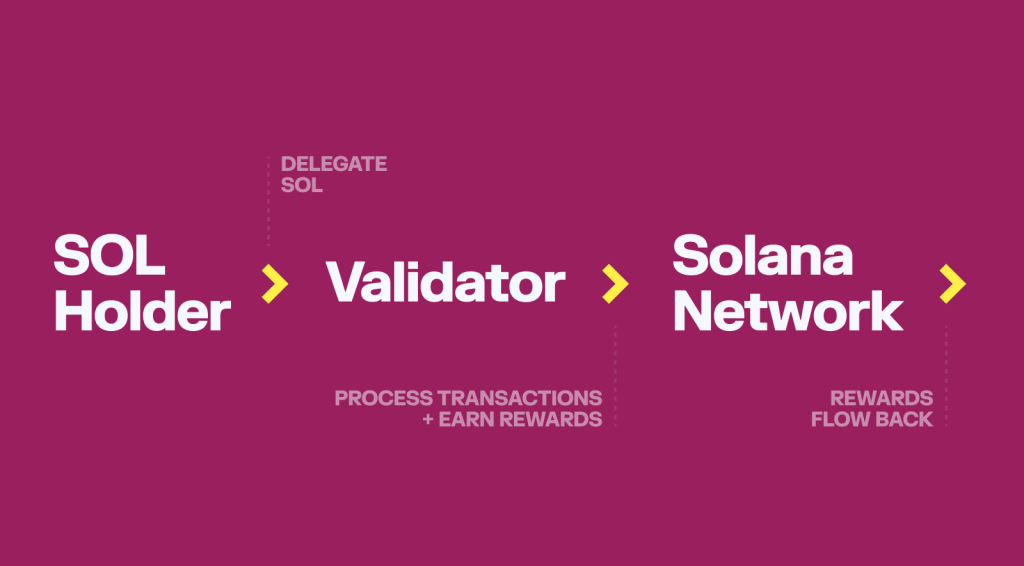
You pick a validator, delegate your SOL, and start accumulating rewards. Your SOL never leaves your wallet. You’re simply telling the network: I’m backing this validator.
Validators: the backbone of the network
Solana’s network is run by validators: nodes that process transactions, verify activity, and add new blocks to the blockchain. The more reliable and well-performing a validator is, the more the network trusts it.
But validators do more than process transactions. They’re how Solana reaches consensus. Validators cast stake-weighted votes on new blocks, and the more SOL delegated to a validator, the more weight their votes carry. This is why staking keeps Solana secure and honest.
When you delegate your SOL, you’re increasing that validator’s voting weight and its share of block rewards. A portion of those rewards flows back to you.
Running a validator requires technical expertise and significant infrastructure. Most regular SOL holders don’t do it themselves (and they don’t need to).
As of 2026, the average stake per validator is around 620,000 SOL – up from 470,000 SOL in 2024.
Delegating your SOL
Instead of running your own validator, you, as the SOL holder, delegate your SOL to one. Delegating means you’re adding your SOL to a validator’s stake, increasing its weight on the network and its share of block rewards. In return, the validator gives a part of those rewards back to you.
This is what staking looks like for the majority of Solana users.
Epochs: how rewards are distributed
Solana organizes time into epochs – periods of roughly two to three days during which the network processes transactions and distributes staking rewards.
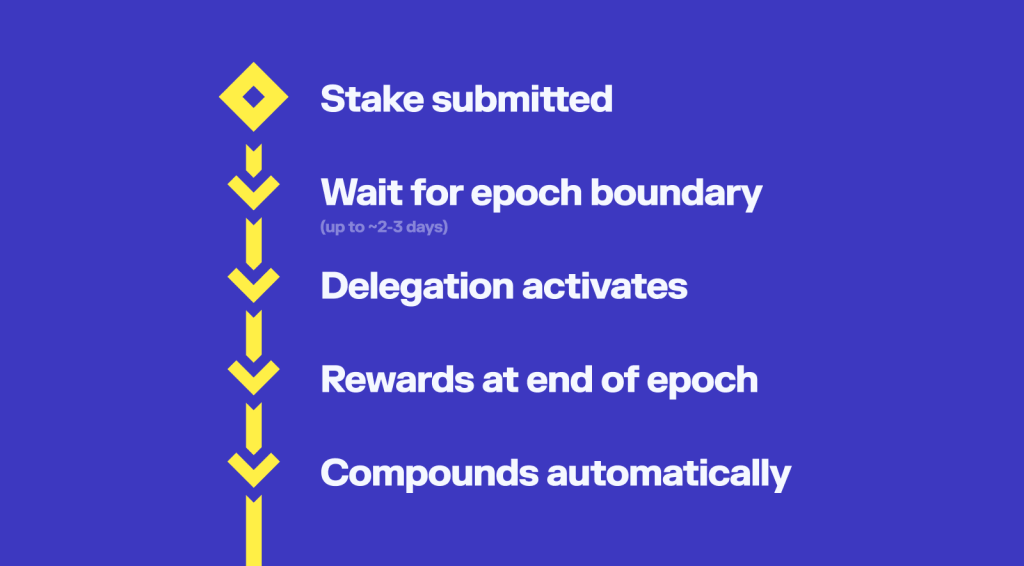
At the end of each epoch, rewards are calculated based on how much SOL you have staked and how well your chosen validator performed. Those rewards are then added directly to your staking account automatically, with no action required on your part.
It’s worth noting that when you first stake, your delegation doesn’t become active until the start of the next epoch. So there’s typically a short activation delay of up to a few days before you start earning.
Where the rewards come from
Solana staking rewards come from two sources: network inflation and transaction fees.
The majority comes from inflation. Solana uses a disinflationary model that started at 8% annual inflation in 2021, reducing by 15% year-over-year to a long-term target of 1.5%. At the time of writing, Solana’s inflation rate is roughly 4%. That’s the design – Solana issues new SOL at a defined rate that decreases over time, and a large portion of that goes to stakers.
A smaller portion comes from transaction fees collected by validators. This is different from a savings account or a DeFi yield product. There’s no one paying you interest. The rewards are built into the protocol itself – they’re part of how Solana is designed to work.
Rewards are generated by the network and distributed automatically, with validators taking a commission before delegators receive their share.
Solana Staking Types: Native vs. Liquid
There are two main approaches, and which one makes sense depends on what you want to do with your SOL while it’s staked.
Native staking
Native staking is what most of this article describes. You delegate your SOL directly to a validator from your own wallet. Your keys stay with you, your SOL stays on-chain under your control, and rewards accumulate automatically each epoch.
It’s the most straightforward option. There are no additional protocols, no smart contract risk, and no extra fees beyond the validator’s commission. The only constraint is the unstaking delay of 2–4 days if you need your SOL back quickly.
For most SOL holders, native staking is the right default.
Liquid staking
With liquid staking, instead of delegating your SOL directly, you deposit it into a protocol and receive a liquid staking token in return (e.g., mSOL from Marinade).
That token represents your staked position and accumulates rewards over time as its value relative to SOL increases.
The key difference is flexibility. You can trade your liquid staking token, use it as collateral in DeFi, or swap it back to SOL at any time, without waiting for an unstaking period. For users who want to stay active in the Solana ecosystem while their SOL keeps earning, that’s an advantage.
It’s worth noting that liquid staking protocols introduce smart contract risk. Well-established protocols like Marinade and Jito have been independently audited, but the risk is never zero. There’s also a protocol fee on top of the validator commission, which can slightly reduce your net yield.
Most long-term SOL holders tend to favor native staking for its simplicity and security, while more active users lean toward liquid staking for flexibility within DeFi.
How Much Can You Earn from Solana Staking?
The honest answer: it depends on a few factors.
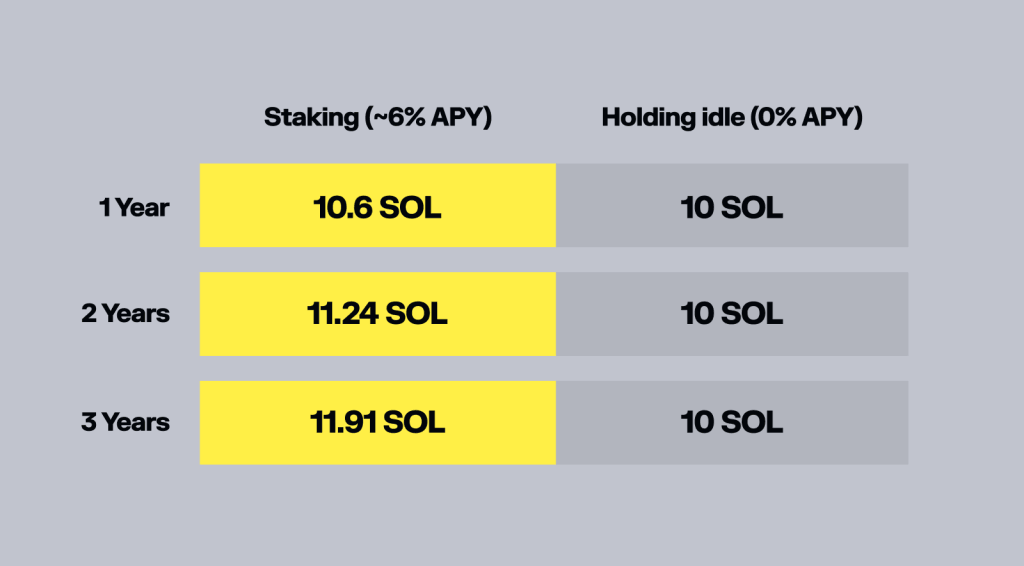
Current APY range
Based on current network data from staking providers, Solana staking currently offers an annual percentage yield (APY) in the range of 5–7%, depending on validator performance, fees, and network conditions.
That’s a meaningful return for simply holding SOL, and it compounds automatically, since rewards are added to your staking balance each epoch and start earning on top of themselves.
To put it in context: if you stake 100 SOL at 6% APY, you’d accumulate roughly 6 SOL over the course of a year, without doing anything beyond the initial setup.
What affects your rewards
Not everyone earns the same rate. A few things influence how much you actually receive:
Validator commission is the cut a validator takes before passing rewards on to delegators. Commissions typically range from 0% to 10%, though some validators charge more. A validator with 5% commission passes 95% of earned rewards to you, so this is worth checking before you delegate.
Validator performance matters too. A validator that experiences downtime or misses blocks earns fewer rewards, which means less for you. Consistent uptime and strong performance simply mean better returns.
Network inflation rate is the other variable. Solana’s inflation started at 8% annually and decreases by 15% each year until it reaches a long-term rate of 1.5%. As inflation decreases over time, so does the baseline staking yield. This is by design – it’s part of Solana’s tokenomics.
Staking conditions: The total amount of SOL staked across the network also affects rewards. When more SOL is staked, yields tend to decrease.
Realistic expectations
Staking rewards on Solana are genuine and consistent but they’re not a get-rich-quick mechanism. Think of them as a yield on an asset you’re already holding, not as a primary investment strategy.
The rewards are also paid in SOL, not in dollars. So the fiat value of what you earn moves with the price of SOL. A strong staking APY combined with a declining SOL price can still result in a net loss in dollar terms. That’s worth keeping in mind when thinking about staking as part of a broader strategy.
Bottom line: staking rewards are real, predictable, and automatic. But they work best when you're already planning to hold SOL long-term, not as a standalone reason to buy it.
*This is not financial advice. Always do your own research before making investment decisions.
Is Solana Staking Safe?
For the most part, staking SOL is considered one of the lower-risk ways to use your crypto.
But like anything in crypto, it’s not completely risk-free. Here’s what to be aware of before you get started.
The Risks of Staking SOL
Unstaking delay
This is the most practical risk for most users. When you decide to unstake your SOL, it doesn’t become available immediately. There’s a cooldown period before your SOL is fully liquid again. This period lasts typically around 2 to 4 days, depending on where you are in the current epoch.
That means if you need access to your funds quickly, staked SOL can’t be used right away. It’s not a dealbreaker, but it’s worth factoring in. Don’t stake SOL you might need on short notice.
Price volatility
Your staking rewards are denominated in SOL. If the price of SOL drops significantly while your funds are staked, and especially during the unstaking window when you can’t move them, the dollar value of your holdings can fall regardless of the rewards you’ve earned.
Staking doesn’t protect you from the market. If the price of SOL goes up or down, your staked SOL follows that price. So while you may be earning rewards, the overall value of your holdings follows the price.
Validator risk
Most validators on Solana are reliable and well-run. But performance does vary. A validator with poor uptime, missed blocks, or technical issues will earn fewer rewards. That flows through to you as a delegator.
The good news is that picking an underperforming validator is a recoverable situation. You can redelegate to a different one at any time, with the change taking effect at the next epoch. It’s not ideal, but it’s not permanent either.
Slashing (and why it’s rarely a concern on Solana)
In many Proof of Stake networks, slashing is a significant risk. It’s a penalty where a portion of a validator’s staked SOL is destroyed if they behave maliciously or make serious errors. It’s one of the first things people ask about when they start looking into staking.
On Solana, slashing exists in the protocol design but has historically been almost non-existent in practice, compared to some other networks. The network relies on other mechanisms like social consensus and validator reputation, to maintain honest behavior. That said, it’s a feature that could be activated in the future, so it’s worth knowing about even if it’s not an active concern right now.
Smart contract risk (liquid staking)
If you use a liquid staking protocol, you’re adding smart contract risk to the equation. These protocols are generally well-audited, but bugs and exploits in DeFi are a real phenomenon. Native staking through a wallet like Solflare doesn’t carry this risk, since there’s no smart contract involved.
How to Stake SOL with Solflare
Staking SOL with Solflare takes a few minutes and doesn’t require any technical knowledge. Everything happens inside the wallet with no external platforms.
What to look for in a validator
Before you stake, you’ll need to pick a validator to delegate to. A few things worth checking:
Commission rate: This is the percentage a validator keeps before passing rewards to delegators. Somewhere between 3–7% is a reasonable range. Zero commission sounds attractive, but it can be a red flag: validators can raise it at any time, and unsustainably low fees often don’t last.
Uptime and performance: A validator that misses blocks earns less, and so do its delegators. Look for consistent performance over time, not just the current epoch.
Stake size: Validators that already hold a disproportionately large share of the network’s total stake contribute to centralization. Choosing a smaller, well-performing validator is better for the network, and Solflare’s interface makes it easy to see where stake is currently concentrated.
You don’t need to agonize over this. Solflare surfaces recommended validators based on performance and decentralization metrics, so you have a solid starting point without doing deep research from scratch.
How to stake your SOL

Step 1: Open Solflare and go to Staking
Navigate to the Staking section in the app. You’ll see your current stake accounts and a list of validators to choose from, each showing commission rates, uptime, and total stake.
Step 2: Choose a validator
Use the criteria above to pick one that fits. If you’re unsure, Solflare’s recommended validators are a reliable default.
Step 3: Enter the amount you want to stake
Decide how much SOL to delegate. You don’t have to stake everything – many people start with a portion of their balance. Just make sure to keep a small amount liquid to cover transaction fees.
Step 4: Confirm the transaction
Review the details and confirm. Your delegation is submitted to the network and will activate at the start of the next epoch – usually within a day or two.
Step 5: Track your rewards
Once active, rewards accumulate automatically at the end of each epoch and are added directly to your staking balance. You can monitor everything inside Solflare – no need to check external tools.
Unstaking follows a similar flow. Select your stake account, choose to deactivate, confirm, and your SOL will be available again after the cooldown period.
See the full step-by-step staking guide for more details.
Ready to put your SOL to work?
Stake your SOL and earn rewards with the most powerful wallet on Solana.
Why People Stake SOL
If you’re holding SOL long-term, staking is one of the easiest ways to make it work for you.
You’re not taking on additional risk, you’re not locking into a complex strategy, and you’re not giving up ownership of your assets. You’re just putting what you already have to work.
For example, staking 100 SOL at 6.25% APY for three years gives you roughly 120 SOL — about 20 extra SOL purely from compounding, without doing anything beyond the initial delegation.
The rewards won’t change your life overnight. But they accumulate steadily in the background, and over months and years, that compounding adds up in a way that simply holding doesn’t.
When staking makes the most sense
Staking is a natural fit if you’re planning to hold SOL for the foreseeable future, don’t need instant access to those funds, and want a low-effort way to earn on top of what you already have.
It makes less sense if you need your SOL to stay fully liquid, for active trading, using it across DeFi, or anything that requires moving it quickly. The unstaking delay is short, but it’s real. If that’s your situation, liquid staking is worth looking at instead
Where to Go From Here
The core idea is simple: if you’re holding SOL anyway, staking lets the network pay you for it. You stay in control of your assets, rewards accumulate automatically, and the whole thing runs in the background without needing constant attention.
The main things to keep in mind going forward:
- Only stake SOL you’re comfortable holding for a while. The unstaking delay is short, but it exists.
- Pick a validator with solid performance and a reasonable commission rate.
- Check in occasionally to monitor rewards and make sure your validator is still performing well.
That’s genuinely it. Staking doesn’t require ongoing expertise or active management. Just a good starting decision and a little patience.
If you don’t have SOL yet, you can buy SOL directly in Solflare. Once you’re set, Solflare makes the staking process straightforward: validator selection, staking, reward tracking, and unstaking all in one place, without leaving your wallet.
FAQs
What is Solana staking?
Solana staking is the process of delegating your SOL to a validator to help secure the network and earn rewards in return.
You keep ownership of your SOL while it’s staked.
How much can you earn from staking SOL?
Staking rewards vary depending on network conditions and validator performance, but they’re typically in a moderate annual range (often a few percent per year).
Rewards are not fixed and can change over time.
Is staking SOL safe?
Staking is generally considered low risk compared to active trading.
You keep control of your funds, but you should still be aware of:
- price volatility
- validator performance
- the unstaking delay
Can I lose my SOL by staking?
In most cases, you won’t lose your SOL just by staking.
On Solana, slashing is not commonly enforced, which reduces the risk compared to some other blockchains.
However, the value of your SOL can still go up or down with the market.
Can I unstake my SOL at any time?
Yes.
You can unstake whenever you want, but there is a short delay (usually a couple of days) before your SOL becomes fully available again.
Do I need a minimum amount of SOL to stake?
Most wallets allow you to stake small amounts of SOL.
However, you’ll need a small balance to cover transaction fees.
Do I need to claim staking rewards manually?
In most cases, no.
Rewards are automatically distributed and added to your staked balance over time.
What is a validator in Solana staking?
A validator is a participant that processes transactions and helps maintain the Solana blockchain.
When you stake SOL, you delegate it to a validator, who shares rewards with you.
Which validator should I choose?
As a beginner, look for a validator that has:
- good uptime/performance
- reasonable fees
- a solid track record
You don’t need to over-optimize – consistency matters more than chasing slightly higher returns.
Can I still use my SOL while it’s staked?
No.
While your SOL is actively staked, it isn’t available for spending or trading.
You need to unstake it first.
Is staking the same as lending?
No.
Staking helps secure the network and earns protocol-level rewards.
Lending involves providing your assets to borrowers and carries different risks.
Is Solana staking better than just holding SOL?
It depends on your goals.
If you’re planning to hold SOL long-term, staking can help you earn additional rewards.
If you need full flexibility or plan to trade frequently, keeping it unstaked may make more sense.