Tokenization is the process of turning ownership of a real-world asset — a stock, a property, a bond — into a digital token on a blockchain. The asset stays in the real world; what moves on-chain is your claim to it. Here's how it works, what can be tokenized, and how you can act on it.
You can already buy a fraction of an Apple share, a US Treasury bond, or a piece of commercial real estate directly from your crypto wallet. Settled in seconds, traded 24/7, with no broker required.
That’s tokenization. And in 2026, it stopped being a concept and became something you can actually use.
The tokenized real-world asset market crossed $43 billion in total market capitalization in 2026, growing over 100% year-on-year, with BlackRock, JPMorgan, Franklin Templeton, and the NYSE all building on-chain infrastructure. The institutions have arrived. The question now isn’t whether tokenization is real but what it actually is and what it means for you as a crypto user.
This guide covers all of it: what tokenization is, how it works, what can be tokenized, and how you can access tokenized assets directly on Solana today.
What Is Tokenization?
Tokenization is the process of converting ownership rights of a real-world asset into a digital token recorded on a blockchain.
In crypto, tokenization specifically refers to representing real-world assets as digital tokens on a blockchain, distinct from how the term is used in payment security.
The asset itself (a building, a stock, a Treasury bill…) stays in the real world, held by a custodian or legal entity. What moves on-chain is a token that represents ownership of it. That token can be bought, sold, transferred, or used in DeFi protocols just like any other digital asset, while the underlying remains exactly where it is.
Think of it like a title deed, but instead of a paper document held in a filing cabinet, it’s a programmable digital record on a public blockchain. It can be transferred in seconds, verified by anyone, and divided into fractions.
A note on the word "tokenization": If you've seen this term in the context of credit cards or payment security (where your card number is replaced with a digital token to protect your data), that's a different concept. This article focuses on asset tokenization: the process of putting ownership of real-world assets on-chain. The two share a name but work very differently.
How Does Tokenization Work?
The mechanics of tokenization are simpler than they sound. At its core, it’s a five-step process that bridges something in the real world to a token on a blockchain.
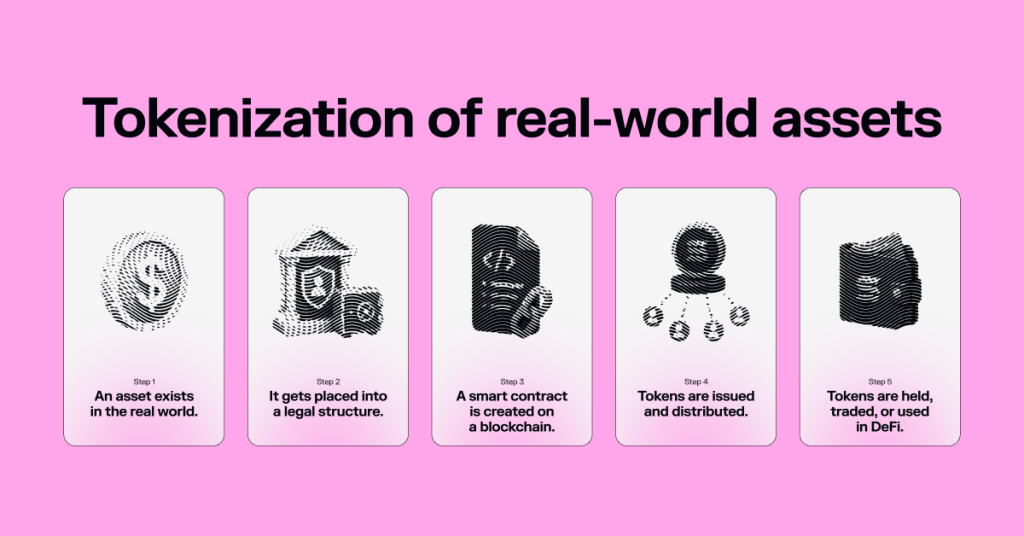
From physical asset to digital token
Step 1: An asset exists in the real world.
This could be a share of Apple stock, a commercial property in Manhattan, a US Treasury bond, or an ounce of gold. The asset has an established value and clear ownership.
Step 2: It gets placed into a legal structure.
Before anything goes on-chain, someone has to establish the legal link between the asset and the token that will represent it. This is typically done through a special purpose vehicle (SPV), a regulated fund, or a licensed issuer — an entity that holds the underlying asset and is legally responsible for it. Backed Finance, for example, holds real shares in custody before issuing any xStock tokens on Solana.
Step 3: A smart contract is created on a blockchain.
The issuer deploys a smart contract that defines the token: how many exist, what rights they carry, how they can be transferred, and any compliance rules that apply. On Solana, this uses the SPL token standard — the same technical foundation that powers every other token on the network.
Step 4: Tokens are issued and distributed.
Once the smart contract is live, tokens are minted and made available through an exchange, a DeFi protocol, or directly in a wallet. Each token represents a proportional claim on the underlying asset. If a property is tokenized into 10,000 tokens, each one represents 0.01% ownership.
Step 5: Tokens are held, traded, or used in DeFi.
From this point, the token behaves like any other on-chain asset. It can sit in your wallet, be traded on a DEX, used as collateral in a lending protocol, or transferred to anyone in the world — instantly, at near-zero cost.
What Assets Can Be Tokenized?
In theory, almost any asset with a clear owner and an established value can be tokenized. In practice, the assets moving on-chain fastest are the ones where legal frameworks already exist and institutional infrastructure is in place.
Financial assets
Stocks and equities. Shares in publicly traded companies can be tokenized and traded 24/7 on-chain. This is already live — Solana accounts for 97% of cumulative tokenized equities spot volume as of May 2026, with xStocks offering tokenized versions of Apple, Tesla, Nvidia, the S&P 500, and dozens of other securities directly accessible from a Solana wallet.
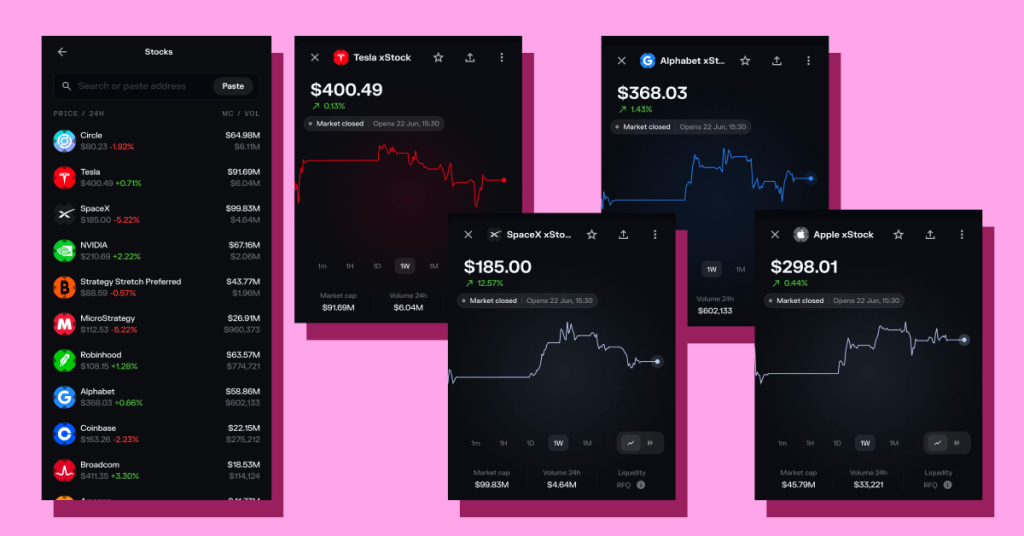
Learn more: How to Buy Tokenized Stocks (xStocks)
Bonds and treasuries. US Treasury bonds were the first asset class to reach meaningful scale in tokenized form. Tokenized US Treasuries hold approximately $15 billion in total value as of early 2026, with BlackRock, Franklin Templeton, and Ondo Finance among the major issuers.
Money market funds. BlackRock’s BUIDL fund, a tokenized money market fund, has become the reference point for institutional tokenization, scaling past $2.5 billion in assets under management and operating across nine blockchain networks.
Private equity and venture funds. Historically accessible only to institutions with minimum investments of $1M+. Tokenization makes fractional participation possible, though regulatory requirements still limit access in most jurisdictions.
Real assets
Real estate. Fractional ownership of commercial and residential properties — from individual buildings to diversified property funds. Tokenization removes the traditional barriers of high minimums and illiquid exit processes.
Commodities. Gold is the most established tokenized commodity, with PAXG and XAUT tracking gold prices on-chain. Oil, carbon credits, and agricultural commodities are also being explored.
Collectibles and alternative assets
Art and luxury goods. High-value physical assets like fine art, rare wine, and collectibles can be fractionalized, allowing multiple owners to hold a share of a single piece.
Intellectual property and royalties. Music royalties, patents, and licensing rights can be tokenized — giving creators a new way to monetize future income streams and investors a new asset class entirely.
What can’t easily be tokenized?
Assets without a clear legal title, disputed ownership, or no established valuation are difficult to tokenize reliably. Jurisdictions that don’t legally recognize a token as a valid ownership instrument create another barrier — the token may exist on the blockchain, but it may carry no enforceable rights in the real world.
The legal wrapper is what makes tokenization work. Without it, you have a token with no real-world backing.
What Are the Benefits of Tokenization?
Tokenization isn’t just a technical upgrade to how assets are recorded — it changes the fundamental economics of investing. Here’s what that looks like in practice.
Fractional ownership
Most high-value assets have historically been out of reach for everyday investors. Commercial real estate requires hundreds of thousands of dollars to enter. Private equity funds set minimums at $1 million or more. Fine art is bought by museums and billionaires.
Tokenization changes the math entirely. When an asset is divided into thousands or millions of tokens, you can own $50 worth of a Manhattan office building or a fractional share of a Picasso. Tokenized stockholders crossed 185,000 in March 2026, up from fewer than 1,500 in December 2024 (as per Falcon Finance) — a sign of how quickly retail access to previously institutional-only assets is expanding.
24/7 liquidity
Traditional markets run on fixed schedules. The NYSE closes at 4 pm. Bonds settle in 1 or 2 business days. Real estate transactions take weeks to close. None of that applies to tokenized assets.
Because tokens trade on a blockchain, they can change hands at any time — midnight on a Sunday, a public holiday, during a market event that happens outside normal hours. On Solana specifically, transactions settle in under a second at fractions of a cent in fees, making high-frequency and micro-transaction activity viable in a way that legacy infrastructure simply can’t support.
Faster settlement
Traditional stock trades typically settle in one business day (formally referred to as T+1 business day). Tokenized assets settle in seconds. That might sound like a minor convenience, but at an institutional scale, it frees up enormous amounts of capital that would otherwise be tied up in the settlement pipeline. JPMorgan has estimated that faster settlement through tokenization could reduce asset management costs by approximately 20%.
Beyond speed, programmable settlement removes the need for clearing houses, intermediaries, and the reconciliation overhead that adds cost at every layer of traditional capital markets.
Transparency and programmability
Every token transfer, ownership change, and transaction is recorded on a public blockchain, which anyone can audit in real time. There’s no back-office reconciliation, no opaque ledger held by a single institution, no waiting for quarterly statements to know where your assets stand.
More significantly, smart contracts can automate what currently requires manual intervention. Dividends can be distributed automatically to every token holder the moment they’re declared. Interest payments on tokenized bonds can be programmed to execute on schedule. Compliance rules like who can hold the token, in which jurisdictions, and under what conditions, can be built directly into the token itself, removing layers of administrative overhead from the issuer’s side.
What Are the Risks of Tokenization?
Tokenization solves real problems, but it doesn’t eliminate risk. It shifts and transforms it. Understanding where the risks actually sit is what separates informed participation from blind optimism.
Regulatory uncertainty
The legal framework around tokenized assets is still being built. Rules vary significantly by jurisdiction: what’s permissible in Switzerland or the EU may be restricted or undefined in the US, Asia, or emerging markets. The GENIUS Act and Clarity Act in the US represent meaningful steps toward regulatory clarity in 2026, but global harmonization is still years away.
For retail investors, the practical implication is that access to certain tokenized assets may be restricted based on where you live, and those restrictions can change. Most tokenized equity products, including xStocks, are currently available to non-US persons only, which is a direct consequence of US securities regulations that haven’t yet caught up with on-chain infrastructure.
Smart contract risk
The rules governing a tokenized asset live in a smart contract. If that code contains a bug or vulnerability, it can affect the token and potentially the ownership claims it represents. Well-established issuers mitigate this through independent audits, but no smart contract is entirely risk-free. This is especially relevant for newer or less-established tokenization platforms.
Counterparty risk
The blockchain tracks ownership perfectly. But the underlying asset (the share certificate, the property title, the gold bar) sits off–chain, held by a custodian or legal entity. If that entity fails, becomes insolvent, or acts improperly, the token’s value is at risk, no matter what the blockchain says.
This is the most underappreciated risk in tokenization. The technology is trustless, but the legal wrapper holding the underlying asset absolutely is not. Always check who the custodian is, whether they’re regulated, and what legal recourse exists if something goes wrong.
Liquidity risk
Not all tokenized assets trade at the same depth and frequency as their traditional equivalents. Tokenized Treasuries and major equities have meaningful liquidity. Tokenized real estate, private credit, and alternative assets often do not, meaning you may hold a token you can’t easily sell at the price you expect.
The 24/7 availability of a token doesn’t guarantee a buyer will always be there at a fair price.
The mirror vs. ownership distinction
This is a subtler risk worth understanding clearly. Some tokenized products track the price of an underlying asset without actually giving you legal ownership of it.
For example, you hold a token that moves with Apple’s stock price, but you may not hold a legal claim to an Apple share in the way a traditional shareholder does.
The distinction matters in edge cases: corporate actions, shareholder votes, legal disputes, and bankruptcy proceedings. Before investing in any tokenized asset, it’s worth understanding whether the token confers actual ownership rights or simply price exposure. Reputable issuers like Backed Finance are explicit about this — their xStocks are backed 1:1 by real shares held in custody, giving token holders genuine economic exposure to the underlying.
Tokenization on Solana
Every major blockchain is experimenting with tokenized assets. But Solana has quietly emerged as the dominant infrastructure for tokenized equities specifically.
Solana accounts for 97% of cumulative tokenized equities spot volume as of May 2026, with over 200,000 tokenized stock holders on the network. That market share didn’t happen by accident. It’s a direct consequence of the infrastructure advantages that make Solana uniquely suited for tokenized assets at scale.
Learn more about Solana: What Is Solana? A Beginner’s Guide to the Solana Blockchain
Why Solana
Speed and cost. Solana processes transactions in under a second at fractions of a cent in fees. For tokenized assets, where fractional ownership, frequent trading, and micro-transactions are the point, this matters enormously. A tokenized real estate investment that requires $5 in gas fees every time you move it defeats the purpose of fractional ownership.
The SPL token standard. Solana’s native token standard makes issuing, transferring, and integrating tokenized assets straightforward. Token Extensions, a more advanced feature set built on top of SPL, allow issuers to embed compliance rules, transfer restrictions, and corporate action handling directly into the token itself, without compromising DeFi composability.
Ecosystem depth. Tokenized assets on Solana aren’t isolated instruments. They plug directly into an existing DeFi ecosystem, trading on Jupiter and Raydium, usable as collateral on Kamino, and displayable natively in wallets like Solflare. The infrastructure to make tokenized assets useful was already there.
xStocks: tokenized equities on Solana
The most concrete example of tokenization on Solana is xStocks — a suite of tokenized US stocks and ETFs issued by Backed Finance, a regulated Swiss entity, and available directly in your Solflare wallet.
Since launch, xStocks has recorded more than $25 billion in total trading volume, with $4 billion settled on-chain and over 85,000 holders participating in the network. In March 2026, xStocks partnered with Nasdaq to bring tokenized equity markets to Solana’s DeFi ecosystem.
What xStocks actually gives you:
- Tokenized stocks and ETFs, including Apple (AAPLx), Tesla (TSLAx), Nvidia (NVDAx), the S&P 500, and dozens of others
- 24/7 trading — no market hours, no brokerage account required
- Fractional ownership — buy as little as you want, with no minimums
- 1:1 asset backing — each token is backed by a real share held in regulated custody
- Automatic dividends — when a supported stock pays a dividend, your token balance increases automatically
- Full self-custody — your xStocks sit in your Solflare wallet, not on an exchange
Solflare is the first non-custodial wallet to integrate tokenized stocks into the user experience natively — available directly in the app, without needing to visit a separate platform.
Trade xStocks instantly
Buy and trade xStocks directly in your Solflare wallet!
Note: xStocks are currently available to non-US persons only, in compliance with applicable securities regulations. Tokenized equities are issued by Backed Assets (JE) in the Jersey Channel Islands under an approved EU prospectus. Always review the relevant terms before investing.
Tokenization vs. Cryptocurrency — What’s the Difference?
These two concepts live in the same ecosystem and are easy to conflate. But they’re fundamentally different things.
Cryptocurrency is a native digital asset. SOL, BTC, and ETH exist only on-chain — they weren’t created to represent something in the real world. Their value comes from supply and demand dynamics, utility within their respective networks, and market sentiment. There’s no underlying asset sitting in a vault somewhere that a Bitcoin “represents.”
Learn more: What Is Cryptocurrency? A Beginner’s Guide to Crypto
A tokenized asset is the opposite. It exists on-chain, but its value comes entirely from something off-chain. A token representing an Apple share is worth approximately what Apple’s stock is worth — not because of anything happening on the blockchain, but because of Apple’s business performance, earnings, and market valuation. The blockchain is the record-keeping and transfer mechanism. The value driver is the real-world asset.
The practical difference matters for how you think about each:
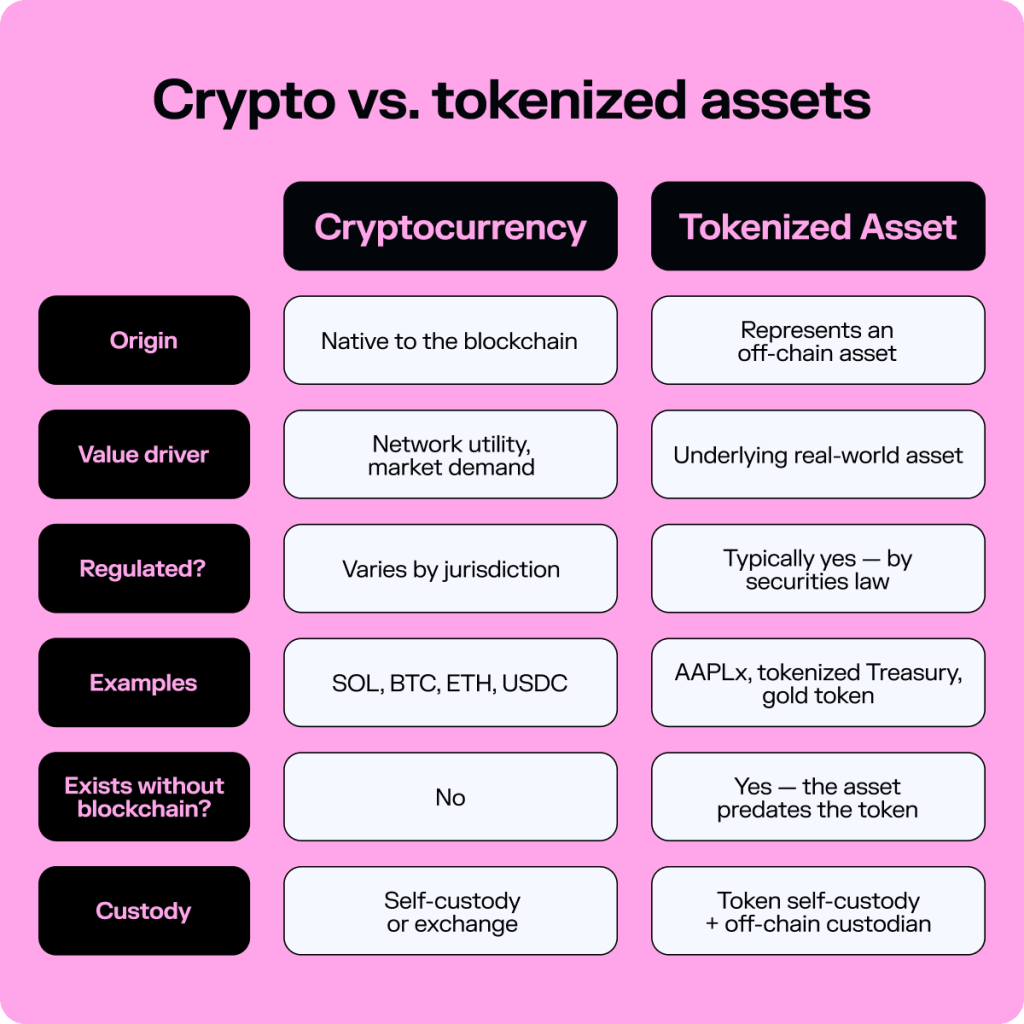
One more distinction worth flagging: most cryptocurrencies are decentralized which means no single entity controls them. Tokenized assets are inherently centralized at the asset level because someone has to hold the underlying. The blockchain handles the ownership record, but the custodian holds the actual thing. That’s not a flaw, just how the two models work differently.
The Tokenization Landscape in 2026
For most of the last decade, tokenization was a promising concept running slightly ahead of its infrastructure. In 2026, that changed. The numbers are real, the institutions are in, and the products are live.
The market today
The tokenized real-world asset market crossed $43 billion in total market capitalization in 2026 — up over 100% year-on-year. To put that in context: the market stood at under $2 billion as recently as 2022. That’s roughly 20x growth in three years, driven by a combination of institutional adoption, improving regulatory frameworks, and maturing on-chain infrastructure.
The breakdown by asset class reflects where institutional confidence is highest:
- Tokenized US Treasuries hold approximately $15 billion in total value — the largest single category, grown from roughly $2.5 billion in late 2024
- Commodities is the second-largest and fastest-growing category
- Tokenized equities are the newest major category and the fastest-growing by holder count, with Solana dominating the infrastructure
Who’s moved on-chain
BlackRock’s BUIDL fund, a tokenized US Treasury money market fund, has scaled past $2.5 billion in assets under management, operates across nine blockchain networks, was accepted as collateral on Binance in November 2025, and became tradable on Uniswap in February 2026. When the world’s largest asset manager puts its name and balance sheet behind a tokenized product, it changes the signal for every other institution watching.
Franklin Templeton, JPMorgan, Fidelity, Goldman Sachs, and Apollo have all launched or significantly expanded tokenized products. The NYSE has announced a dedicated venue for 24/7 trading and settlement of tokenized securities. Nasdaq partnered with xStocks to bring tokenized equities to Solana’s DeFi ecosystem in March 2026.
Where it’s headed
The forecasts vary in scale but agree on direction. McKinsey projects the tokenized asset market will reach $2–4 trillion by 2030. BCG and Ripple put the upper estimate at $18.9 trillion. Standard Chartered forecasts $30 trillion by 2034.
More than half of the world’s top 20 asset managers are expected to have tokenization strategies by the end of 2026. The global stock of real estate, bonds, commodities, and private credit is worth approximately $450 trillion. Less than $40 billion of it sits on-chain today. The infrastructure to close that gap is being built right now — and Solana is one of the primary rails it’s being built on.
Where to Go From Here
Tokenization is what happens when the blockchain stops being about speculation and starts being about ownership. The infrastructure is live, the institutions are in, and the assets are real — you can buy a fraction of Apple stock or a US Treasury bond from your crypto wallet right now, with full self-custody and no broker required.
If you want to explore tokenized assets on Solana, Solflare is the place to start. xStocks are available directly in the app — no separate platform, no extra steps, just your wallet.
This article is for educational purposes only and does not constitute financial or investment advice. Tokenized equities (xStocks) are issued by Backed Assets (JE) in the Jersey Channel Islands under an approved EU prospectus and are currently available to non-US persons only. Always review the relevant terms and conditions before investing.
Frequently Asked Questions
What is tokenization in simple terms?
Tokenization is the process of turning ownership of a real-world asset (a stock, a property, a bond) into a digital token on a blockchain. The asset stays in the real world, held by a custodian. The token is what moves on-chain, representing your claim to it.
What is the difference between tokenization and cryptocurrency?
Cryptocurrency exists only on-chain and derives its value from network utility and market demand. A tokenized asset represents something off-chain — its value comes from the underlying real-world asset. The blockchain is the record-keeping mechanism. The value driver is external.
What is RWA in crypto?
RWA stands for Real-World Assets — tokenized assets that derive their value from something off-chain. Stocks, bonds, real estate, gold, and private credit are all RWAs. The tokenized RWA market crossed $37.5 billion in 2026, up over 100% year-on-year.
What assets can be tokenized?
Stocks and ETFs, US Treasury bonds, money market funds, real estate, gold and commodities, private credit, and art are all live and active. The assets that tokenize most readily are those with existing legal frameworks and established custodial infrastructure.
Is tokenization safe?
Tokenization carries real but manageable risks: smart contract risk, counterparty risk, regulatory uncertainty, and liquidity risk. For established products from a regulated issuer, like xStocks on Solana, the risk profile is meaningfully better than newer or unaudited alternatives.
How do I invest in tokenized assets?
The most accessible way on Solana is through Solflare. xStocks (tokenized US stocks and ETFs) are available directly in the app’s Market tab under Stocks. Buy fractional amounts using SOL or USDC, with no brokerage account and full self-custody. Note that xStocks are currently available to non-US persons only.