Perpetual futures, or perps, are crypto contracts that let you trade the price of an asset with leverage and without an expiry date. Unlike buying crypto directly, you don't own the underlying asset, but take a position on where the price goes.
Something big is happening with crypto trading lately: spot trading, the simple act of buying and holding an asset, is no longer where most crypto trading activity happens. Perpetual futures have taken over.
This guide walks through what they are, how the mechanics work, what they cost, the risks worth knowing, and how to trade them on Solana.
What are perpetual futures?
A perpetual future, or perp, is a derivative contract that lets you trade the price of a crypto asset without owning it and without an expiry date.
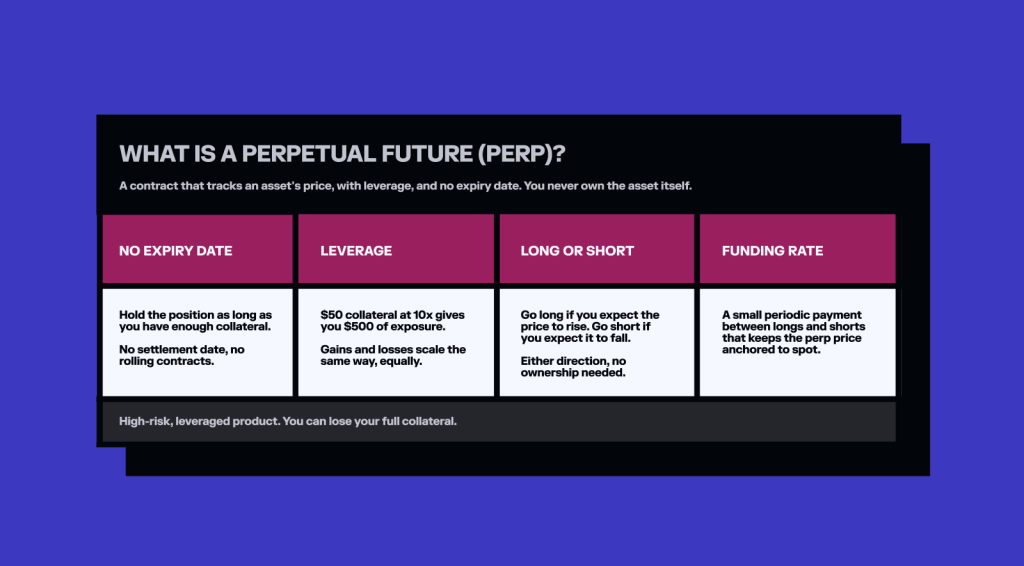
Two ideas are crucial here:
- You don’t own the asset. When you open a perp position on BTC, you’re not buying Bitcoin. You’re entering a contract whose value tracks Bitcoin’s price. If the price goes up and you’re positioned correctly, you profit. If it goes down, you lose, again without ever holding actual BTC.
- There’s no expiry date. Traditional futures contracts settle on a specific date, forcing you to close the position or roll it into a new contract. A perp has no such deadline. You can hold a position open for an hour, a week, or a year, as long as you maintain enough collateral to keep it alive.
Perps exist largely because crypto trades 24/7, and a contract with a fixed expiry date doesn’t fit that rhythm well. They first appeared on the exchange BitMEX in 2016 and have since become the dominant trading instrument in crypto. (More on how they compare to traditional futures in the FAQ below.)
You’ll see them referred to by a few different names. “Perpetual futures,” “perpetual swaps,” and “perpetuals” all mean the same thing. “Perp” is just the informal shorthand traders use.
Perps vs. spot vs. traditional futures
Perps sit between two more familiar ways of trading: spot trading and traditional futures.
Spot trading
Spot trading is the simplest form: you buy an asset at the current market price and you own it. Spot trading is what you do every time you “buy” crypto on an exchange or in your wallet. If you buy 1 SOL, you have 1 SOL. There’s no leverage, no expiry, and no contract. Your gain or loss is a direct, one-to-one reflection of the token’s price movement.
Spot is the right starting point for most people, and it’s what most beginners do first: buy SOL, hold it, maybe stake it.
Traditional futures
A traditional futures contract is an agreement to buy or sell an asset at a set price on a specific future date. The defining feature is the expiry date: when it arrives, the contract settles, and you either close your position or roll it into a new one. This mandatory settlement creates timing decisions and friction, which is what many traders find inconvenient in a market that never actually closes.
Perpetual futures
Perps take the leverage from traditional futures and remove the expiry date entirely. You get leveraged exposure to an asset’s price with no forced settlement, no rolling contracts, no timing pressure from a calendar. Instead, a mechanism called the funding rate (covered below) keeps the perp’s price aligned with the actual spot price over time.
Here’s how the three compare directly:
| Spot | Traditional Futures | Perpetual Futures | |
| Own the asset? | Yes | No | No |
| Expiry date | None | Fixed date | None |
| Leverage available | No | Yes | Yes |
| Can go short | No | Yes | Yes |
| Can be liquidated | No | Yes | Yes |
| Ongoing cost | None | Margin/roll costs | Funding rate, paid or received |
| Settlement | Immediate | On expiry | Never (funding rate instead) |
Here’s the takeaway: if you want to simply own an asset, spot is the tool. If you want leveraged price exposure with the flexibility to hold as long as you want, that’s what perps are built for.
How do perpetual futures work?
There are several concepts you need to understand to truly grasp how perpetual futures work.
Collateral and leverage
Collateral is the money you actually put up when you open a perp position. It’s an amount of USDC or another asset that backs your trade. It’s also what you stand to lose if things go wrong.
Leverage is the multiplier applied to that collateral to determine how much of the market you’re actually exposed to, and that resulting number, your position size, is what determines your actual profit or loss in dollar terms, not your collateral amount.
Let’s say you put up 100 USDC, which equals $100. At 10x, your $100 controls $1,000 worth of the asset, even though you only paid $100.
If the price moves 5% in your favor, you don’t gain 5% of your $100, you gain 5% of your $1,000 position, which is $50. That’s a 50% return on your actual $100. If the price moves 5% against you, you lose $50 the same way, a 50% loss on your collateral.
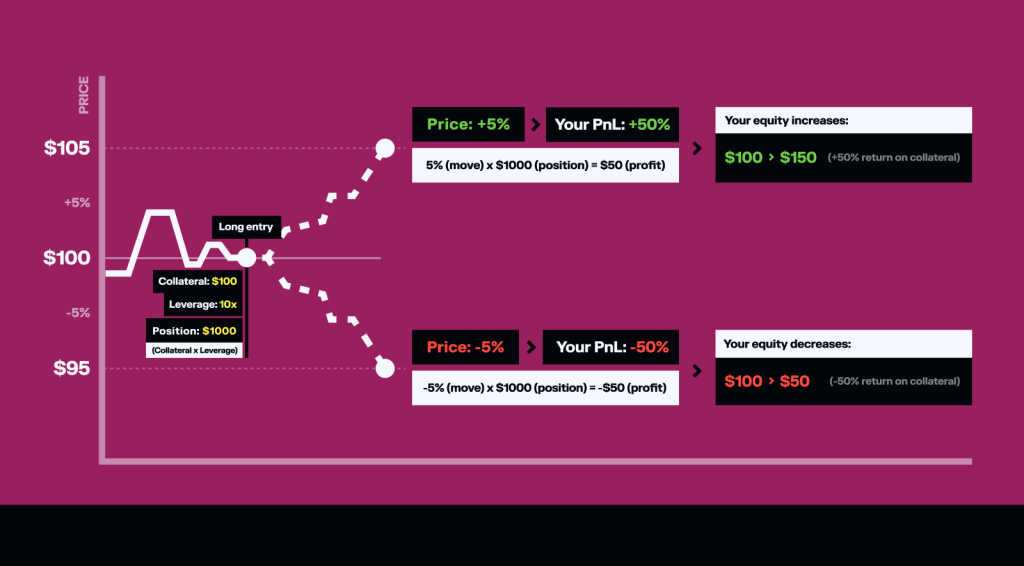
Leverage magnifies both outcomes equally. Higher leverage means more exposure from less capital, but it also means smaller price moves can wipe out your position. This tradeoff is the single most important thing to internalize before trading perps.
Going long and going short
When you open a perp position, you choose a direction.
Going long means you’re betting the price will rise. If it does, you profit. Going short means you’re betting the price will fall. If it does, you profit from a price decline, without ever having sold an asset you own.
This is one of the most useful features of perps: you can profit from a falling market just as easily as a rising one, something that's far more difficult to do with spot trading alone.
Example (long): You believe SOL will rise from $200. You open a long position with $100 collateral at 10x leverage, giving you $1,000 of exposure. SOL rises to $210, a 5% move. Your position gains 5% × 10 = 50% of your collateral, or $50. You close the position with $150.
Example (short): You believe BTC will fall from $70,000. You open a short position with $100 collateral at 5x leverage, giving you $500 of exposure. BTC drops to $66,500, a 5% decline. Because you’re short, that decline works in your favor: you gain 5% × 5 = 25% of your collateral, or $25. You close the position with $125, profiting from a price you never owned as it dropped.
The examples above are simplified. In practice, your actual profit is usually a little lower than this due to possible slippage and trading fees. Orders don't always fill at exactly the price you're aiming for (slippage), and most platforms charge a small trading fee on both entry and exit. This means you might end up with $148 instead of $150 from the ideal example.
Liquidation
Every leveraged position has a liquidation price: the point at which your collateral falls below the minimum the venue requires to keep the position open. When the market reaches that price, the position closes automatically, and the collateral behind it covers the loss.
Because this minimum sits above zero, the position actually closes a little before your collateral is fully wiped out, which is why the numbers below are approximate rather than exact. The higher your leverage, the closer this price sits to your entry, meaning less room for a normal price swing before you’re at risk.
Example: You open a long on SOL at $200 with $50 collateral at 20x leverage, giving you $1,000 of exposure. At 20x leverage, your liquidation buffer is thin, so 4-4.5% (rather than the full 5%) price move against you would already bring your collateral down to the venue’s minimum and close the position. Compare that to the same $50 collateral at 2x leverage: your exposure would only be $100, giving you a much wider buffer, SOL would need to fall somewhere close to 50% before the same thing happened.
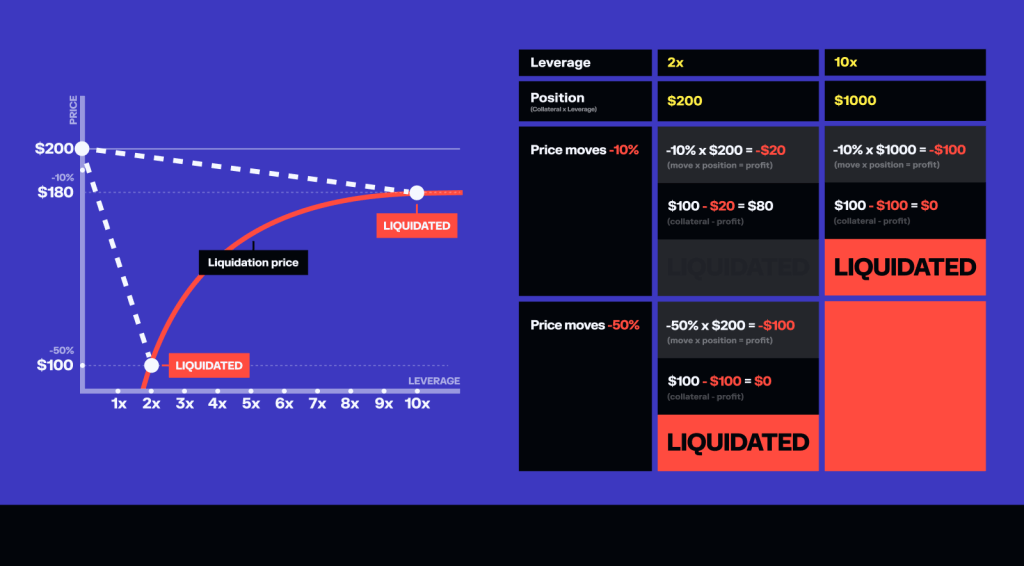
Your liquidation price is where your collateral drops below the minimum the venue needs to keep the position open. That point comes before your collateral is fully gone, which is why a small amount is sometimes returned.
Liquidation prices are shown before you open a position and remain visible throughout the life of the trade, so you always know how much room you have.
Mark price and index price
A perp trades on its own market, with its own buyers and sellers, so its price can drift from the spot price of the underlying asset. To avoid basing your position’s profit, loss, and liquidation on a single, possibly manipulated or glitchy price feed, platforms use two reference prices instead:
The index price is a broad market average for the asset, pulled from multiple sources. The mark price is derived from that index and is what actually determines your unrealized profit or loss and your liquidation.
This is why liquidation can sometimes happen at a price slightly different from what a basic chart shows. The platform is protecting the calculation, not moving the goalposts.
The funding rate
Since perps have no expiry date and no forced settlement, there needs to be some way to keep the perp’s price tethered to the actual spot price of the asset. That’s what the funding rate does.
Periodically (every hour or so), a small payment is exchanged directly between traders holding long positions and traders holding short positions. If the perp is trading above spot, longs pay shorts. If it’s trading below spot, shorts pay longs.
Example: More traders are long on BTC than short, pushing the perp price slightly above spot. The funding rate is +0.01% per hour, paid by longs to shorts. You’re holding a $1,000 long position. Every hour, you pay $0.10 to the short side of the market. Over a week (168 hours), if the rate stays constant, that’s about $16.80 in funding costs, even if BTC’s price hasn’t moved at all. If you were short instead, you’d be receiving that $16.80.
Funding is symmetric; you can end up paying it or receiving it depending on which side of the market you’re on. But it’s not just a cost or a bonus sitting off to the side: since funding payments come out of your collateral, holding a position on the paying side for long enough can quietly move your liquidation price a little closer, even if the market itself hasn’t moved against you. It’s one reason perps generally suit shorter-term positions better than long-term holding.
Trading fees
Opening and closing a perp position costs a fee, charged as a percentage of your position size. Most platforms charge a maker fee (for orders that add liquidity) and a taker fee (for orders that fill immediately), typically somewhere in the range of 0.01-0.1%, though it varies by platform. You pay this on both entry and exit.
Key terms you’ll encounter when trading perps
Once you open a perp trading interface, you’ll run into a handful of terms. Here are some of the most common ones:
Position size: Your total market exposure, calculated as collateral × leverage. This is the number that determines your actual profit or loss in dollar terms, not your collateral amount.
Mark price: The price used to calculate your unrealized profit or loss and to determine liquidation. Typically an average derived from several sources to prevent manipulation.
Index price: A reference price representing the broader market average for an asset, used alongside the mark price to keep it anchored to reality.
Open interest: The total value of all open positions in a market. Higher open interest generally signals more active trading and deeper liquidity.
Liquidation buffer: The percentage distance between the current price and your liquidation price. A larger buffer means more room before liquidation; a shrinking buffer is a warning sign.
Isolated margin: A setup where each position uses only the collateral assigned to it. If that position gets liquidated, only that collateral is lost, not your other open positions.
Cross margin: The opposite setup, where multiple positions share a single collateral pool. A loss on one position can draw from the collateral backing another.
Auto close (Take profit / Stop loss): Pre-set price levels that automatically close your position once reached. It’s not a guarantee of the exact price you set. In a fast-moving market, the order executes at the next available market price once triggered, which can land worse than your target.
The risks of trading perps
Leverage cuts both ways, evenly
This is worth repeating: leverage amplifies gains and losses by the exact same amount. No version of leverage gives you more upside than downside. The excitement of leverage tends to focus on the upside; the discipline required is remembering the downside is equally real, every time.
Liquidation can happen quickly
In a fast-moving market, the distance between “the position is fine” and “the position is liquidated” can close in seconds, especially at higher leverage. This is why liquidation prices and buffers are worth checking before you open a trade, not just once you’re already worried about the position.
Take profit and stop loss aren’t guaranteed prices
Auto Close is useful, but it’s not a promise. When your trigger price is hit, the order executes at the next available market price, and in a fast-moving or gapping market, that can be noticeably worse than the level you set. Treat it as a way to manage risk automatically, not as a guarantee of the exact outcome you planned for.
Ongoing costs add up over time
Funding payments and trading fees are both small on their own, but they add up if you’re trading actively or holding a position for a while. Funding can go either way, you might pay it or get paid, but if you’re stuck paying it for a long stretch, it eats into your returns. Fees work similarly, just charged per trade instead of per hour.
That said, these aren’t the real reason perps are better for short-term trading. That comes down to leverage and liquidation risk, covered above. Funding and fees are just a smaller thing worth keeping in mind on top of that.
Perps amplify emotional decision-making
Because outcomes move faster and larger relative to your capital than with spot trading, perps put more psychological pressure on every decision. That pressure leads to the classic mistakes: closing winning positions too early out of fear, holding losing positions too long hoping for a reversal, or increasing size to chase back a loss.
They’re not designed for long-term holding
Spot trading suits holding an asset for months or years. Perps generally don’t, primarily because leveraged positions need active monitoring of your liquidation price as markets move, and secondarily because ongoing costs like funding and fees chip away at returns held over long periods. If you want long-term exposure to an asset, spot or staking is almost always the more appropriate tool.
Why perps have become the dominant way to trade crypto
Perps aren’t a niche corner of crypto trading anymore. They’re the majority of it.
According to KuCoin’s 2026 market analysis, perpetual futures and derivatives constitute 73–78% of total crypto trading volume, with Bitcoin perp-to-spot ratios frequently hitting 6:1. The same analysis puts cumulative perpetual volume at approximately $14 trillion over a six-month period.
A few things explain why: perps match crypto’s always-on trading culture in a way contracts with fixed expiry dates never could, and they package leverage and shorting into a single, standardized product available on almost every exchange and, increasingly, directly from self-custody wallets.
The onchain side is growing fastest of all. Decentralized perpetual exchanges have expanded dramatically, with perp DEX volume growing roughly eightfold in the same period that overall perp volume grew 75%. The same analysis notes platforms like Hyperliquid posting individual quarters with close to $500 billion in derivatives volume, numbers that now rival established centralized exchanges.”
This shift toward onchain, self-custody perp trading is the same shift that makes trading perps directly from a wallet like Solflare possible.
The product keeps expanding beyond crypto-native assets. Perpetual contracts now extend into tokenized equities, commodities, and index-linked products, not just BTC and ETH. Some platforms already offer perps on tokenized ETFs and individual stocks, extending the model well beyond its original crypto use case.
Perps on Solana
Solana has become one of the most active environments for onchain perpetual futures trading.
Speed and cost. Perp trading involves frequent order placement, quick adjustments, and time-sensitive decisions, exactly the kind of activity that benefits from Solana’s sub-second transaction times and near-zero fees. Adjusting a position or reacting to a fast market rarely costs more than a fraction of a cent.
Different market structures. Onchain perp platforms are built on a few different models. Some use a pooled liquidity model with oracle-based pricing. Others, like Phoenix Trade (the protocol powering perps in Solflare), run an order book instead, matching buy and sell orders against each other the way a centralized exchange does. This gives traders a market structure closer to what they’re used to from CEXs, but fully onchain and non-custodial.
Full self-custody throughout. Trading perps onchain through a self-custody wallet (like Solflare) means you sign every transaction from your own wallet, and your collateral stays on Solana for the life of the position, held by the protocol’s onchain programs. There’s no exchange account and no custodian standing between you and your funds.
How and where to trade perps?
For years, trading perps meant depositing funds onto a centralized exchange and trading from a balance the platform controlled. That’s no longer the only option. Self-custody wallets on Solana now let you open, manage, and close perp positions directly, with your collateral held by the protocol’s onchain programs rather than sitting on an exchange’s balance sheet.
Solflare surfaces perp markets directly inside the same wallet where you already hold and trade your assets, no separate platform or account required. If you want the full walkthrough, covering opening positions, managing leverage, and setting take-profit and stop-loss levels on both mobile and desktop, it’s covered step by step in our app guide.
*Perpetual futures are high-risk, leveraged products. You can lose everything you commit. Not suitable for all users, not available in all regions.
Solflare provides the software interface only: your positions are opened and held on the Phoenix protocol, you transact with the protocol directly and no compensation scheme covers your funds. Review the Material Risk Disclosures of Phoenix to make sure you understand the risks and commit only funds you can afford to lose.
A perp gives you leveraged exposure to the price of an asset (a cryptocurrency, a stock, an ETF or a commodity) without owning it. You never own the underlying asset and you have no rights against the company or issuer it references. The perps feature is not available in the United States or the United Kingdom and is blocked entirely in jurisdictions subject to comprehensive sanctions. Solflare's Terms of Service apply.
FAQs
A perpetual future, or perp, is a contract that lets you trade an asset’s price with leverage and no expiry date, without ever owning the asset itself. You can go long if you expect the price to rise or short if you expect it to fall.
“Perp” is shorthand for perpetual future, sometimes also called a perpetual swap or perpetual contract. All three terms refer to the same instrument.
A traditional futures contract has a fixed expiry date, forcing you to close or roll the position. A perpetual future never expires, staying open as long as you maintain enough collateral, with a funding rate keeping its price aligned with spot instead.
The funding rate is a small periodic payment exchanged between long and short traders that keeps a perp’s price aligned with the underlying spot price. Depending on market positioning, you’ll either pay or receive this payment, typically every hour.
Lower leverage, generally in the 2-5x range, gives you significantly more room before liquidation and is a safer starting point while you learn how positions behave. Higher leverage should be approached only once you’re comfortable with the mechanics and risks involved.
If the market reaches your liquidation price, the position closes automatically and the collateral backing it is lost. This happens without warning or grace period, which is why monitoring your liquidation price and buffer matters throughout the life of a trade.
With isolated margin, no. Your loss is capped at the collateral assigned to that specific position, and the rest of your wallet or account is unaffected. This is different from cross margin, where multiple positions share the same collateral pool.
No. An option gives you the right, but not the obligation, to buy or sell an asset at a set price, and it has its own separate risk profile. A perpetual future is a direct, ongoing bet on price direction with leverage, and no such optionality.