For SOL holders, staking is one of the simplest decisions you can make — if you're already holding and not selling tomorrow, you might as well earn some yield on it. Here's what you actually get, what can go wrong, and how to know if it's the right move for you.
The short answer is yes. For most SOL holders, staking is one of the simplest decisions you can make. If you’re already holding SOL and not planning to sell it tomorrow, leaving it unstaked means leaving yield on the table for no reason.
But “worth it” depends on your situation, and the longer answer has some nuance to it. This article breaks down what you actually get from staking, what the trade-offs are, and how to know whether it makes sense for you specifically.
Quick answer: For most people who already plan to hold SOL long-term, yes. You earn a variable yield of roughly 5.5% to 8% a year for very little effort, and not staking lets inflation slowly dilute your share of the network. It isn't a reason to buy SOL you wouldn't otherwise hold, and it does nothing to shield you from price swings. Staking makes a long position work harder; it doesn't make a risky bet safe.
What You Actually Get from Staking SOL
Before deciding whether staking is worth it, it helps to know exactly what you’re getting.
When you stake SOL, you delegate it to a validator, which is a node that helps process transactions and secure the Solana network. In return, the network pays you a share of its inflation-based rewards. Your SOL stays yours throughout. You’re not lending it, selling it, or handing it to a company. You’re simply putting it to work.
Learn more about Solana staking: What Is Solana Staking? Earn Rewards with Your SOL
Now let’s get into the numbers.
The numbers
Solana staking currently yields in the range of 5.5–8% APY, depending on the validator you choose and current network conditions. That compounds automatically. At the end of each epoch (roughly every 2–3 days), earned SOL is added to your staking balance and immediately starts earning on top of itself.
Here’s what that looks like in practice:
| Starting amount | APY | After 1 year | After 3 years |
| 10 SOL | 6% | ~10.6 SOL | ~11.9 SOL |
| 100 SOL | 6% | ~106 SOL | ~119 SOL |
| 1,000 SOL | 6% | ~1,060 SOL | ~1,191 SOL |
These figures are in SOL terms — the fiat value moves with SOL’s price. But the compounding effect is real regardless of where the price goes.
What staking doesn’t do
Staking doesn’t protect you from price movements. If SOL drops 30%, your staked SOL drops 30% too. The rewards soften that impact slightly, but they don’t reverse it. Staking is a yield mechanism on an asset you’re already holding, not a hedge against market risk.
It’s also worth mentioning how Solana’s inflation model affects staking. Solana’s initial inflation rate of 8% decreases by 15% annually until it reaches a long-term floor of 1.5%. That means staking yields will gradually compress over time — they’re competitive now, but locking in good habits early makes a difference.
Why Most SOL Holders Should Be Staking
If you’re holding SOL with a medium or long-term view, the argument for staking is straightforward. Here’s why it makes sense for most people.
It’s yield on something you already own
You don’t need to take on additional risk to stake. You’re not buying a new asset, entering a leveraged position, or trusting a third party with your funds. You’re earning a return on SOL you were already holding, with your private keys intact and your assets under your control the entire time.
The opportunity cost of not staking is real. Every epoch your SOL sits unstaked is yield you’re not earning. Over a year, that’s 5.5–8% of your holdings. Over three years, compounded, it’s meaningfully more.
The barrier to entry is essentially zero
Setting up staking in Solflare takes under five minutes. There’s no minimum amount, no application process, no technical knowledge required. You pick a validator, enter an amount, confirm, and rewards start accumulating automatically at the next epoch. There’s nothing to monitor or manage day-to-day after that.
You’re contributing to the network (which benefits you)
When you stake, you’re increasing a validator’s voting weight — which strengthens the network’s security and decentralization. A more secure, more decentralized Solana is directly in the interest of anyone holding SOL. Staking is one of the few situations in crypto where the incentive structure genuinely aligns individual reward with collective benefit.
The compounding effect is underrated
Because rewards are added to your staking balance automatically each epoch, they start earning on top of themselves almost immediately. Most people underestimate what this means over multi-year horizons. Staking 100 SOL at 6% APY for five years gives you roughly 130 SOL, not from doing anything, but purely from compounding. On larger holdings, that gap becomes significant.
It works whether the market is up or down
In a bull market, your staking rewards accumulate alongside price appreciation: you end up with more SOL and each SOL is worth more. In a bear market, staking accumulates more SOL while prices are low, effectively lowering your average cost basis over time. It’s one of the few strategies that has a reasonable argument for both market conditions.
What to Keep in Mind Before You Stake
Staking SOL is low-risk relative to most things you can do in crypto. But low-risk isn’t no-risk, and there are a few things worth understanding before you commit.
Your rewards are paid in SOL, not dollars
This is the most important thing to keep in mind. Staking yields are denominated in SOL. If SOL’s price falls significantly while your funds are staked, the dollar value of your holdings, including your rewards, falls with it.
A 6% APY in SOL doesn’t protect you from a 30% price drop. What staking does is ensure you accumulate more SOL over time, regardless of price. Whether that’s worth more in fiat terms depends entirely on where SOL trades when you eventually sell.
There’s an unstaking delay
When you decide to unstake, your SOL doesn’t become liquid immediately. There’s a cooldown period of roughly 2–4 days before you can move or sell it. In normal conditions, that’s barely noticeable. In a fast-moving market (a sharp price drop, a sudden opportunity), that window can matter.
If you think you might need access to your SOL on short notice, either keep some unstaked for flexibility, use Solflare’s instant unstake option for a small fee, or consider liquid staking protocols like Jito or Marinade, which let you exit via a DEX swap at any time. See our full platform comparison.
Yields will compress over time
The gradual declinein Solana’s inflation rate flows through to staking yields. The 5.5–8% range you can earn today will be lower in three years, and lower still in five.
This isn’t a reason not to stake, compounding at today’s rates still adds up meaningfully. But it’s worth having accurate expectations rather than assuming current yields are permanent.
Validator choice matters
Not all validators perform the same. A validator with poor uptime or high commission reduces your effective yield. It’s not a catastrophic risk – you can redelegate at any time, but it’s worth spending a few minutes checking commission rates and uptime history before you delegate. Solflare surfaces this data directly in the staking interface, so you don’t need to go elsewhere to find it. Learn more about how Solana staking works.
Tax implications
In most jurisdictions (including the US), staking rewards are treated as taxable income at the time you receive them, based on the fair market value of the SOL at that moment. If you later sell that SOL at a higher price, you may also owe capital gains tax on the difference.
Tax treatment varies by country and is still evolving in some jurisdictions. Before staking significant amounts, it’s worth understanding how your local rules apply. This article isn’t tax advice. Always consult a crypto-aware accountant if you’re unsure.
How Does Solana Staking Compare to Alternatives?
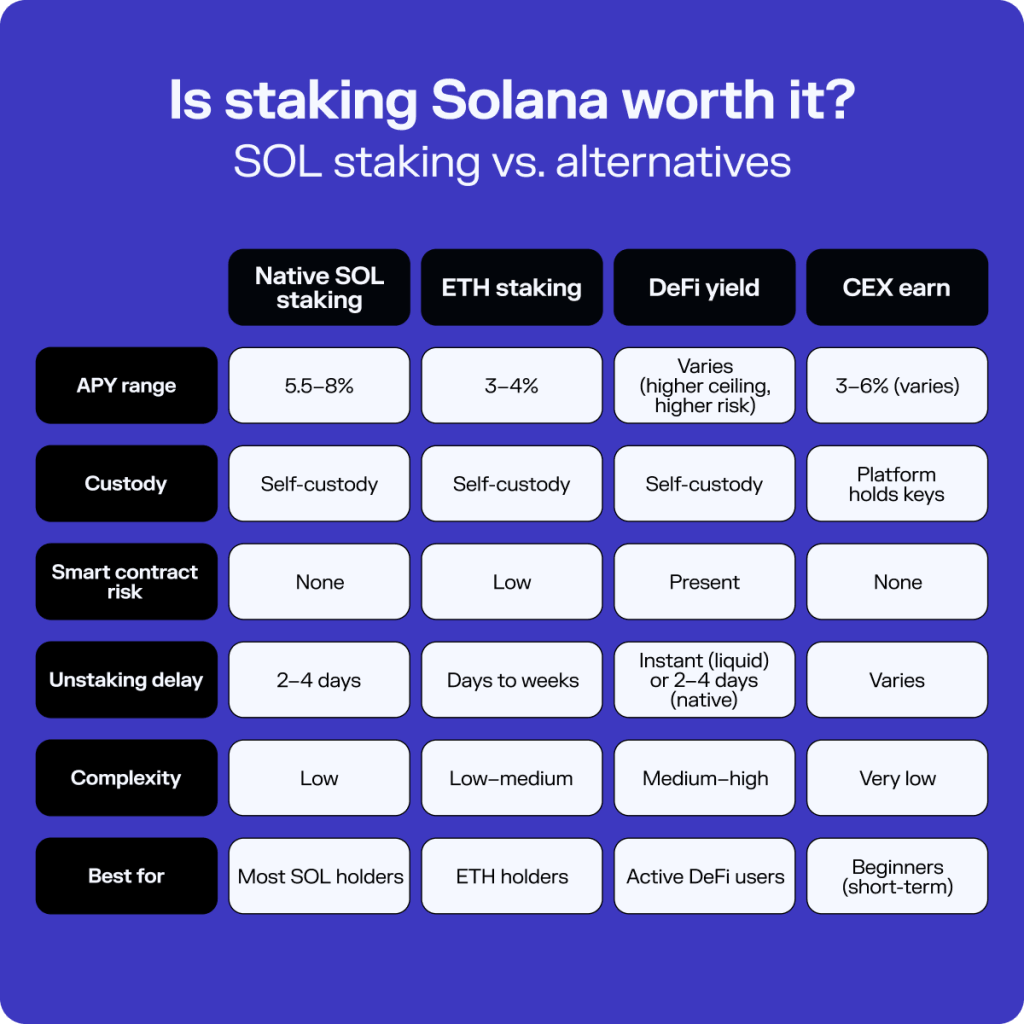
Staking isn’t the only way to put SOL to work. Here’s how it compares to the alternatives.
SOL staking vs. just holding
Holding SOL without staking means your position stays flat in SOL terms while the network’s inflation distributes rewards to everyone who is staking. In effect, unstaked SOL is slowly diluted relative to staked SOL over time. Staking is the baseline: it’s what you do to keep pace with the network’s reward distribution, not an aggressive yield strategy on top of it.
If you’re holding SOL long-term anyway, not staking is the active choice that requires justification, not the other way around.
SOL staking vs. ETH staking
ETH staking currently yields around 3–4% APY — meaningfully lower than Solana’s 5.5–8% range. Ethereum also has a longer unstaking queue that can take days or weeks, depending on network demand, compared to Solana’s predictable 2–4 day cooldown. On the custody side, both can be done non-custodially from a wallet, though Ethereum’s 32 ETH minimum to run a validator is a much higher bar than Solana’s effectively zero minimum for delegation.
For holders of both assets, Solana staking offers better yield with comparable mechanics and lower friction.
SOL staking vs. DeFi yield strategies
DeFi protocols on Solana, like lending, liquidity provision, and yield strategies, can offer higher headline APY than native staking. But they come with meaningfully more risk: smart contract risk, impermanent loss for liquidity providers, protocol-specific risks, and more complexity to manage.
Native staking has no smart contract risk, no impermanent loss, and no active management required. The yield is lower than the best DeFi opportunities in a bull market — but it’s also far more consistent and far less likely to blow up. For most holders, the risk-adjusted return on native staking compares favourably to chasing higher DeFi yields.
There are also liquid staking protocols like Jito and Marinade that sit somewhere in between. They add smart contract risk and a protocol fee, but give you DeFi composability in return. Worth considering if you want to use your staked position within DeFi, but native staking remains the simpler and safer baseline.
Looking for where to stake Solana? 6 Best Platforms for Staking Solana in 2026
SOL staking vs. centralized exchange yield products
Some exchanges offer SOL yield products: fixed or flexible savings accounts, earn programmes, and similar. The headline rates are often comparable to or lower than native staking, but you’re giving up custody of your SOL to earn them. Given what happened to exchange-held assets during FTX and similar collapses, that trade-off is hard to justify when native staking offers similar or better returns with full self-custody.
Who Should Stake SOL?
The honest answer is: most people holding SOL. Here’s a quick breakdown by situation.
You’re holding SOL long-term → Stake it. You’re already committed to the asset, you don’t need immediate liquidity, and every epoch you’re not staked is yield you’re leaving behind. Native staking through Solflare is the simplest setup — no smart contract risk, no protocol fees, full custody.
Learn more: How to Stake SOL With Solflare
You’re actively trading SOL → Stake the portion you’re not actively trading. The 2–4 day unstaking delay means you can’t react quickly with staked SOL, so keep your trading allocation liquid. The rest can compound in the background.
You’re new to crypto → Start with native staking through Solflare. It’s one of the most beginner-friendly things you can do with SOL — no technical knowledge, no minimum, no separate platform required. If you’re not comfortable with self-custody yet, a custodial platform like a CEX works as a starting point, though fees are higher and you give up custody.
You want to use your SOL in DeFi → Consider liquid staking protocols like Jito or Marinade. They let you earn staking rewards while keeping your position usable as DeFi collateral. The trade-off is smart contract risk and a protocol fee.
You’re holding a significant amount of SOL → Pair native staking with a hardware wallet like Solflare Shield. Your private keys stay offline while everything else works exactly the same. For large holdings, that extra layer is worth it.
How to Start Staking
Native staking is close to set-and-forget. In Solflare you pick an amount, choose a validator (the app shows commission and performance, so you’re not guessing), and confirm. Rewards accrue and compound on their own, and the desktop and mobile flows match.
If you decide it’s worth it, here’s how to stake SOL using Solflare. Weighing where to stake? Compare the best platforms for staking Solana. When you’re ready, start staking on Solflare; your keys stay yours the whole time.
Frequently asked questions
How much can you make staking Solana?
At roughly 5.2% to 6.5% a year, staking 100 SOL earns about 5 to 7 SOL over a year, paid in SOL and compounding automatically. The rate varies with your validator, and the dollar value rises and falls with the SOL price. Use the calculator on the Solflare staking page to estimate your own figure.
Is Solana staking safe?
Native staking on Solflare is non-custodial, so you never hand your SOL to a third party. Solana also doesn’t currently slash staked funds for validator errors, so a weak validator costs you rewards, not principal. The real risks are price volatility and the lock-up periods, not losing your coins.
Can you lose money staking Solana?
Not from staking itself; your SOL isn’t at risk of being taken. But you can lose money in dollar terms if the SOL price falls while you hold, exactly as with unstaked SOL. Staking adds tokens; it doesn’t hedge price.
How long is your SOL locked when you stake?
There’s a warm-up of about two epochs (roughly two days) before rewards begin, then a cool-down of one to three epochs (about two to six days) to unstake, followed by a manual Withdraw step. If you need instant access, that delay is the main thing to weigh.
Do you keep ownership of your SOL while it’s staked?
Yes. With native staking you delegate to a validator but never transfer ownership. The SOL stays in your wallet’s control the entire time.
Is staking Solana worth it for a small amount?
The minimum is 0.01 SOL and the 0.002 SOL account fee is refundable, so no amount is mechanically too small. Since idle SOL earns nothing and still gets diluted by inflation, staking even a small amount beats leaving it untouched.