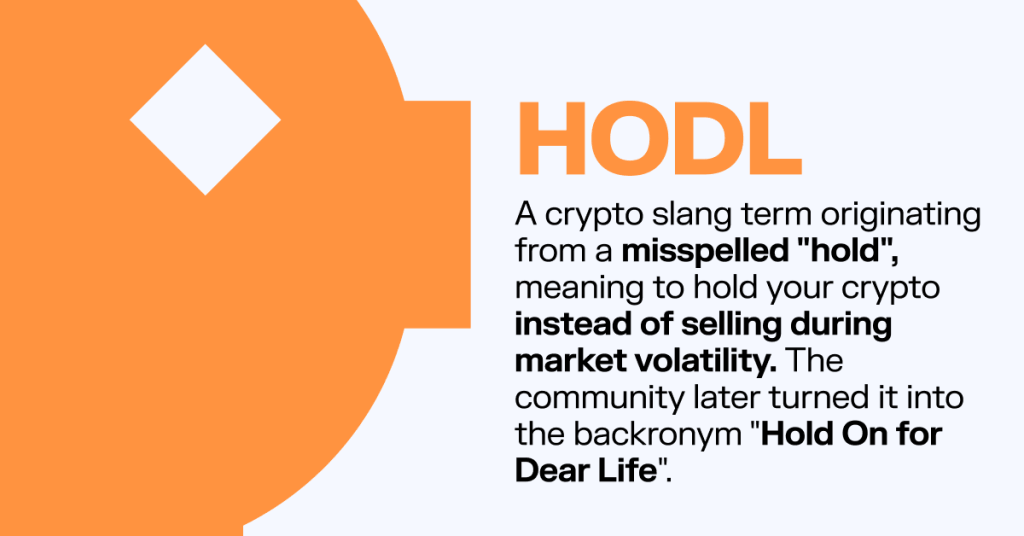
HODL means holding a crypto asset long-term instead of trading it. The word started as a misspelling of "hold" on a Bitcoin forum in 2013; the acronym "hold on for dear life" was invented afterward. As a strategy, it works for assets you genuinely believe in, not as a reason to hold everything forever.
You saw it in a thread, probably in all caps, probably during a red week: HODL. Yes, it is a typo. It also happens to be the closest thing crypto has to an official investment philosophy. This is the origin, the strategy, and how to do it properly.
What does HODL mean in crypto?
HODL is a slang term for holding your crypto long-term instead of trying to trade it — especially during periods of downturns, price swings and general market volatility. If someone says they’re HODLing Solana, they mean they have no plans to sell. Not this dip, not this week’s drama.
It’s pronounced “hoddle,” rhyming with “waddle,” though plenty of people just say “hold” and nobody gets ejected from the group chat. And no, it didn’t start as an acronym. You’ll see “hold on for dear life” everywhere, and it’s a decent description of the experience, but that expansion was invented after the fact. The original word was a typo, typed by a person who knew it was a typo and posted it anyway. Crypto decided the mistake was the brand, and honestly, it fits.
The origin: one drunk forum post
On December 18, 2013, at 10:03 a.m. UTC, a Bitcointalk user called GameKyuubi opened a thread titled “I AM HODLING.” Bitcoin had climbed from around $150 that spring to a peak near $1,100 in late November, and by mid-December it was correcting hard. People were panic selling. GameKyuubi was not.
He knew the title was wrong: “I type d that tyitle twice because I knew it was wrong the first time. Still wrong. w/e.” He admitted he’d been drinking whisky, then wandered off into whether it’s spelled “whisky” or “whiskey.” But buried in the mess was an actual thesis. “WHY AM I HOLDING? I’LL TELL YOU WHY. It’s because I’m a bad trader and I KNOW I’M A BAD TRADER.” And the line that made the post immortal: “In a zero-sum game such as this, traders can only take your money if you sell.”
Within an hour the forum had turned it into memes, riffing on 300 and Braveheart. Twelve years later the typo has outlived most of the exchanges that existed when it was typed. There’s an ETF on the New York Stock Exchange that trades under the ticker HODL. Not bad for a spelling error.
The self-awareness is the part worth keeping. HODL was never “the price only goes up.” It was one person admitting they couldn’t outtrade the professionals, so they weren’t going to try. That’s a more honest starting point than most trading strategies ever get.
Is HODLing a good strategy?
For tokens you’d want to own anyway, yes. Trying to time a market this volatile is how most people lose money, and GameKyuubi’s logic still holds: if you know you’re not a great trader, refusing to trade is a defensible edge. Every swap has fees and slippage, every panic sell has a cousin called buying back higher, and doing nothing costs nothing.
But HODL is not a substitute for thinking. Holding a strong asset through volatility is a strategy. Holding a dead meme coin to zero is denial with a nicer name — the community calls that bag holding, and every long-time holder has done it at least once. On Solana, where a token can go from launch to legend to abandoned in a month, the difference matters more than it does anywhere else. HODLing works in proportion to how much conviction the asset actually deserves.
It also isn’t the only way in. HODL answers “when do I sell?” — ideally, not for a long time. Dollar-cost averaging answers “when do I buy?” — regularly, in fixed amounts, so no single entry point can wreck you. They pair naturally: DCA in, HODL on. And plenty of reasonable holders take profits in slices on the way up rather than treating any sale as a betrayal. The forums fight about this endlessly; you’re allowed to have an exit plan and still call yourself a HODLer.
One more reason people hold, at least in the US: selling is usually a taxable event. Assets held longer than a year are generally taxed at lower long-term rates than quick flips, and staking rewards typically count as income when you receive them. Rules differ by country and change often — treat this as context for why the strategy exists, not tax advice.
Here’s a practical breakdown of when HODLing actually makes sense:
| If you’re… | HODL? | Why |
| A long-term SOL believer | Yes | Volatility comes with the ride. Stake it while you wait. |
| Holding established SPL tokens you researched | Yes, with a plan | Conviction plus periodic review beats set-and-forget-forever. |
| Sitting on a meme coin that already did its 100x | Probably not all of it | Taking some profit after a 100x is just math. |
| Down 80% on a token with no team and no volume | No | Conviction requires a thesis. If the thesis is gone, the position should be too. |
| Someone who needs the money within a year | No | Volatile assets are for money you can afford to leave alone. |
How to HODL safely
If you’re going to hold for years, where you hold becomes the whole game.
Coins on an exchange are an IOU. The company holds the keys; you hold a login. That’s fine for a week of trading, and a real risk over a multi-year HODL — holders who kept funds on FTX, Voyager, or Celsius learned that the most disciplined diamond hands in the world can’t help you when withdrawals freeze. The crypto phrase for this is “not your keys, not your coins,” and it stopped being a slogan and became a survival rule sometime around November 2022.
Self-custody fixes that specific failure. In a wallet like Solflare, your keys live with you, and no company’s balance sheet sits between you and your SOL. The trade is that you take on the responsibility: your seed phrase is the wallet, so write it down and store it offline, and never type it into a website that asks for it. Our wallet security best practices cover the full setup, and Solflare’s security stack handles scam detection automatically.
For holdings that are large or genuinely long-term, the standard upgrade is a hardware wallet, which keeps your keys on a device that never touches the internet. A HODL measured in years deserves storage designed for years.
Don’t just hold it, let it work
This is the part that makes HODLing on Solana different from HODLing anywhere else, and somehow no definition of the word ever mentions it.
Idle SOL can be staked. You delegate it to a validator, it helps secure the network, and it earns a variable yield of around 5.4% a year, paid in more SOL. It’s non-custodial, so the coins never leave your control — which makes it the rare yield that doesn’t quietly reintroduce the exchange risk you just escaped. You were going to hold anyway; staking means the holding compounds.
HODLing SOL is one thing. HODLing SOL while it earns up to 8% a year in staking rewards is better.
HODL slang cheat-sheet
HODL travels with an entire vocabulary. Here are some other terms you’re bound to stumble upon:
| Term | Meaning |
| Diamond hands | Holding through anything. The HODLer’s badge of honor. |
| Paper hands | Selling at the first sign of trouble. The insult. |
| Bag holder | Someone still “HODLing” an asset that already died. |
| FUD | Fear, uncertainty, and doubt. What HODLers accuse sellers of reading. |
| FOMO | Fear of missing out. Buying the top because the chart went vertical. |
| Rekt | What happens to leveraged traders. HODLers watch from the sidelines. |
| To the moon | Where every holder’s token is allegedly headed. |
| BUIDL | HODL’s cousin. Where HODL means don’t sell, BUIDL means don’t wait — build products, contribute code, create content, grow the ecosystem instead of just riding it. |
FAQs
Officially, nothing. HODL began as a misspelling of “hold” in a 2013 Bitcointalk forum post titled “I AM HODLING.” The expansion “hold on for dear life” was invented later as a backronym. It stuck because it captures the experience, but the typo came first.
Most people say “hoddle,” rhyming with “waddle.” Saying “hold” is also fine and everyone will know what you mean. There’s no official ruling, which is fitting for a word born from a spelling mistake.
For assets you have real conviction in, holding long-term beats frequent trading for most people: fewer fees, fewer mistimed exits, and in many countries better tax treatment after a year. It’s not a reason to hold weak tokens forever, though. HODLing a strong asset is discipline; HODLing a dead one is a bag.
The mechanics are the same: buy, then don’t sell for a long time. The difference is context. Buy-and-hold comes from stock investing and usually implies diversified index funds. HODL is crypto-native, applies to far more volatile assets, and comes bundled with a culture of holding through drawdowns that would terrify a stock investor.
Yes, and on Solana you arguably should. Native staking lets you delegate SOL to a validator and earn a variable yield around 5.2% to 6.5% a year while keeping full ownership of your coins. Your HODL earns more SOL instead of sitting idle. The main trade-off is an unstaking delay of a few days.
In a wallet where you control the keys. Exchanges hold your coins for you, which adds a company-failure risk that grows with your time horizon. A self-custody wallet removes that middleman, and a hardware wallet adds another layer for large, long-term holdings by keeping keys offline entirely.