Crypto trading means buying and selling digital assets to profit from price movements. This guide covers everything a beginner needs to get started: how to choose a platform, how to place your first trade, what to buy, how to read a chart, and how to manage risk.
Buying crypto is straightforward. Trading is a different skill entirely. What platform do you use? What do you trade? What does a limit order mean? How much should you start with?
This guide answers all of it. It’s written for beginners, people who’ve probably bought some crypto before, but have no idea how to actually trade it.
What Does Trading Crypto Actually Mean?
Crypto trading refers to buying a digital asset at one price and selling it at a higher price, or selling first and buying back lower if you’re betting on a price decline. The goal is to profit from price movements rather than simply holding an asset for the long term.
Trading vs. Investing
Trading and investing in crypto both involve buying it, but the time horizon and intent are completely different.
Investing means buying and holding an asset based on a long-term belief in its value. You buy SOL, put it in your wallet, and hold for months or years. Short-term price dips don’t (or at least shouldn’t) affect your actions because you are in it for the long term.
Trading means actively buying and selling over shorter timeframes like days, hours, or even minutes, to profit from price movements. The focus shifts from “do I believe in this asset?” to “where is the price going, and when?”
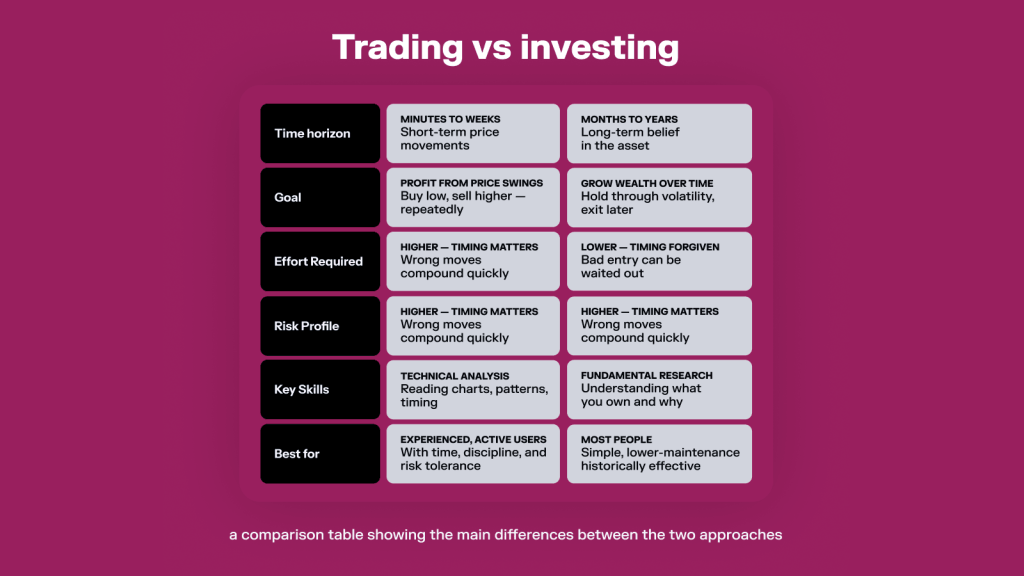
The distinction matters because they require different mindsets, different tools, and different risk tolerance. Long-term investing is forgiving of bad timing; if you buy at the wrong moment but your thesis is right, you can wait it out.
Trading is not forgiving. A 20% price move against your position hurts, and a leveraged position can be wiped out entirely.
Most beginners who call themselves traders are actually closer to investors — they buy and hold, check prices frequently, and sell when they panic or when they need the money. That’s fine, but it’s worth knowing which category you’re in before you start thinking about strategies and order types.
Spot trading vs. more complex products
This guide focuses on spot trading, which is the most straightforward form of crypto trading. You buy an asset, you own it, and you sell it when you’re ready. The price you pay is the current market price. There’s no borrowing, no contracts, no expiry dates.
More complex products like futures, margin trading, options, and perpetual contracts let you trade with borrowed money or bet on price direction without owning the underlying asset. They can amplify gains, but they amplify losses just as fast. Most experienced traders have stories of getting liquidated. Most beginners shouldn’t go near them until they’ve spent serious time with spot trading first.
Two Ways to Trade Crypto: CEX vs. DEX
Before you place your first trade, you need to decide where you’re going to trade. There are two fundamentally different options, and the choice affects everything from how you sign up to who holds your funds.
Centralized exchanges (CEX)
A centralized exchange is a company-operated platform where you create an account, deposit funds, and trade through its interface. Coinbase, Kraken, and Binance are the most widely used. They handle custody of your assets, provide fiat on-ramps (so you can buy crypto with a bank transfer or card), offer deep liquidity, and have customer support.
The trade-off is custody. When your crypto sits on an exchange, the exchange holds your private keys. You have a balance displayed in an account and not actual on-chain ownership. For active trading, that’s often fine. For holding anything meaningful long-term, it’s a risk worth understanding.
CEX trading is the right starting point if you’re new to crypto entirely, want to buy with fiat, or prefer a familiar interface with customer support available.
Decentralized exchanges (DEX)
A DEX is a protocol that runs on a blockchain. You trade directly from your wallet via smart contracts. There’s no creating accounts or KYC verification. You connect using your wallet and have full self-custody over your funds. On Solana, the main DEXs are Jupiter and Raydium, and Solflare has a built-in DEX aggregator that automatically finds the best rate across them.
The trade-off is that you need to already hold crypto in your wallet to start. You can’t deposit fiat directly. The typical flow is either buying on a CEX first, then transferring to your wallet, or buying directly through your wallet via one of the onramping options. There’s also no customer support in the traditional sense. If you send funds to the wrong address, no one can recover them.
DEX trading is the right choice if you already hold crypto, want full custody of your funds, don’t want to hand over personal information, or want access to the full range of tokens on Solana (many of which aren’t listed on centralized exchanges).
Most people end up using both — a CEX to buy and convert, a wallet for holding and onchain activity. They’re not mutually exclusive.
Learn more: Crypto Wallet vs. Exchange: What’s the difference?
How to Place Your First Trade
On a centralized exchange (CEX)
Step 1: Choose and sign up to an exchange.
Pick a reputable exchange that operates in your country. Coinbase and Kraken are the most beginner-friendly options in the US. Binance has the widest asset selection globally but has regulatory restrictions in some jurisdictions. Sign up, complete KYC verification, and secure your account with two-factor authentication before doing anything else.
Step 2: Deposit funds.
Once verified, deposit fiat via bank transfer or card, or transfer crypto from another wallet or exchange. Bank transfers are slower but cheaper. Card deposits are instant but carry higher fees. Check the fee structure before depositing, since it can vary significantly between platforms.
Step 3: Find the asset you want to trade.
Navigate to the trading section and search for the asset you want. Assets are organized into pairs ( BTC/USD, SOL/USD, ETH/USDC), meaning you’re buying one asset with another. For beginners, stick to fiat pairs to keep things simple.
Step 4: Choose your order type and place the trade.
Select the amount you want to buy and your order type.
There are three order types worth knowing:
Market order: buys or sells immediately at the current market price. The simplest option. You get filled instantly but have no control over the exact price, which can vary slightly in fast-moving markets. For most beginners making their first trade, this is fine.
Limit order: lets you set the exact price you want to buy or sell at. If SOL is trading at $150 and you only want to buy at $140, you set a limit order at $140 and it executes automatically if the price reaches that level. It may never fill if the price doesn’t reach your target, but you get price certainty when it does.
Stop-loss order: automatically sells your position if the price drops to a level you set. If you buy SOL at $150 and set a stop-loss at $120, the exchange sells automatically if it hits $120, capping your loss at 20%. A basic but important risk management tool.
Review the fee before confirming. Your purchased asset will appear in your exchange balance immediately after the order fills.
Step 5: Move your funds to a wallet when you’re done trading.
Once you’re done actively trading, transfer your holdings to a self-custody wallet. Leaving funds on an exchange for a longer period exposes you to platform risk; exchange failures, withdrawal freezes, and hacks are all real and documented. Hold only the amount intended for trading daily on your exchange account.
On a DEX with Solflare
You can swap tokens directly from your own wallet via a decentralized exchange, without creating an account, completing KYC, or handing custody of your funds to anyone.
In this case, your wallet is your identity, and trades execute directly on-chain via smart contracts. Here’s how it works in practice.
Step 1: Set up your wallet.
Download Solflare on iOS, Android, or as a Chrome extension. Create a new wallet, write down your seed phrase on paper, and store it somewhere physically secure. That seed phrase is the only way to recover your wallet, so treat it accordingly. See How to Set Up Your First Solana Wallet for more info.
Step 2: Fund your wallet with SOL or USDC.
You need crypto in your wallet before you can trade. Buy crypto directly in your wallet via an onramp or transfer it from a CEX to your wallet address.
Step 3: Open the Swap tab in Solflare.
Navigate to the Swap section in the Solflare app. Solflare’s built-in DEX aggregator automatically finds the best available rate across Solana’s liquidity pools, so you don’t need to compare exchanges manually.
Step 4: Select your tokens and amount.
Choose the token you’re swapping from (e.g. USDC) and the token you want to receive (e.g. SOL, or any other SPL token). Enter the amount. Solflare will show you the expected output, the price impact, and the fee before you confirm.
Step 5: Review and confirm the transaction.
Solflare simulates the transaction before you sign it, showing you exactly what will happen. Review it, confirm, and the swap executes on-chain in under a second. The new token appears in your wallet immediately.
The key difference from CEX trading: every step happens on-chain, in your custody, with no intermediary. You own your assets at every point in the process.
What to Trade? (How to choose a crypto to trade)
Choosing what to trade matters as much as how you trade it. The wrong asset can make a sound strategy unprofitable. Here’s how to think about it.
Start with the majors
For your first trades, stick to the three most established cryptocurrencies: Bitcoin (BTC), Ethereum (ETH), and Solana (SOL).
Bitcoin (BTC) is the most liquid and most widely traded crypto asset in the world. Its price moves are well-documented, there’s abundant publicly available analysis, and it tends to be the most stable of the three in relative terms. If you want to understand how crypto markets move, watching Bitcoin is the clearest lens.
Ethereum (ETH) is the backbone of the largest smart contract ecosystem. It has deep liquidity across every major exchange and DEX, and its price behavior is widely covered. It tends to follow Bitcoin’s direction but with more volatility.
Solana (SOL) is the asset you’ll interact with most directly if you’re trading in the Solana ecosystem. It has strong liquidity on both CEXs and DEXs, active ecosystem development, and is required for paying transaction fees on the Solana network, meaning you’ll want to hold some regardless.
All three have one thing in common that makes them appropriate starting points: deep liquidity. At any given moment, billions of dollars worth of BTC, ETH, and SOL are being traded across hundreds of platforms. That depth means your trades execute at or very close to the displayed price, and you can exit a position quickly if you need to.
Avoid low-cap altcoins early
Low market cap tokens (coins with a total value of under $100 million, and especially under $10 million) behave completely differently from the majors. A few reasons to avoid them until you have real trading experience:
Thin liquidity. You might buy a token at $1.00 and immediately push the price to $1.10 through your own purchase, then find no buyers when you try to sell, and have to accept $0.85 to exit. This is called price impact, and it compounds your losses.
No track record. BTC has over 15 years of price history. Most low-cap altcoins have months. Without meaningful historical data, technical analysis is largely guesswork since there aren’t enough patterns to identify support levels, trend behavior, or how the asset responds to broader market moves.
Asymmetric information. The people trading obscure tokens often know far more about them than you do. Insiders, developers, early holders, and organized groups are frequently on the other side of your trade. You’re not competing with other beginners but with people who bought in months earlier and are waiting for retail volume to exit into.
Manipulation. Low-cap tokens require far less capital to manipulate. Pump-and-dump schemes are common and largely undetectable until the price collapses.
Prone to hype: Altcoins like meme coins are especially prone to hype and sentiment across social networks, which makes it incredibly hard to predict their price movement and dynamics.
Research indicates that roughly 25% of all cryptocurrencies listed on centralized exchanges like Binance have been deliberately targeted by pump-and-dump groups at least once, with the frequency scaling drastically higher for coins that end up delisted.
None of this means small-cap tokens are always bad investments. Some become the next major asset. But identifying which ones do requires deep research, high risk tolerance, and some expertise. It’s not where you should be starting.
Watch out for liquidity and volatility
Before trading any asset, check two things:
Liquidity is how easily you can buy or sell without affecting the price. On a CEX, look at the order book depth — a healthy market has many buyers and sellers at prices close to the current price. On a DEX, Solflare shows you the price impact of your trade before you confirm. If a $500 swap shows a 5% price impact, the liquidity is thin and you should reconsider.
Volatility is how much the price moves over a given period. Crypto is volatile relative to most asset classes — a 10% daily move in BTC is unusual but not unheard of, and smaller tokens can move 50% or more in a day. Higher volatility means higher potential gain and higher potential loss. Know what you’re comfortable with before entering a position.
Types of Crypto Trading
Here’s a quick overview of the main types. The approach that suits you depends on how much time you have, how much risk you’re comfortable with, and what you’re trying to achieve.
Spot trading
Spot trading is what this entire guide has been describing. You buy an asset, you own it, and you sell it when you’re ready. No leverage, no contracts, no expiry dates. The price you pay is the current market price and the asset is yours immediately.
It’s the most straightforward form of trading and the right starting point for beginners. Lower risk than leveraged products, easier to understand, and forgiving enough that mistakes don’t have to be catastrophic.
Day trading
Day trading means opening and closing positions within a single trading day — sometimes within hours or minutes. The goal is to profit from short-term price movements rather than holding overnight.
It sounds appealing but it’s genuinely difficult. Most retail day traders lose money, and the ones who don’t have put in significant time developing skills in technical analysis, risk management, and emotional discipline. If you’re new to trading, treat day trading as something to work toward — not where you start.
Swing trading
Swing trading sits between day trading and long-term investing. You hold positions for days or weeks, aiming to capture a meaningful price move — a “swing” — rather than micro-movements within a single session.
It’s more accessible for beginners than day trading because it doesn’t require constant monitoring. You identify a setup, enter a position, set a stop-loss, and check in periodically rather than watching every tick. It still requires real analysis, but there’s far less time pressure.
Futures and margin trading
Futures and margin trading let you trade with borrowed money, meaning you can take a position larger than your actual capital. A 10x leveraged position means a 10% price move in your favor doubles your money. It also means a 10% move against you wipes it out entirely.
These products are not for beginners. Even experienced traders regularly get caught out. Learn spot trading thoroughly before going anywhere near leverage.
Dollar-cost averaging (DCA) as an alternative
If active trading feels like more complexity than you want right now, dollar-cost averaging is worth understanding as a simpler alternative. Instead of trying to buy at the perfect moment, you invest a fixed amount regularly (e.g., $50 every week) regardless of price.
When prices are high, you buy less. When prices are low, you buy more. Over time, your average cost smooths out, and you remove the pressure of trying to time entries perfectly. For most people holding crypto over a multi-year horizon, DCA consistently outperforms attempts at market timing, with significantly less stress and screen time.
Reading Crypto Charts
Charts are how traders visualize price history and identify potential future moves. You don’t need to master technical analysis before your first trade, but knowing how to read a basic chart means you’re making decisions based on information rather than gut feeling.
Candlestick charts
The most common chart type in crypto trading is the candlestick chart. Each candle represents price movement over a specific time period. This period can be one minute, one hour, one day, etc., depending on the timeframe you’ve selected.
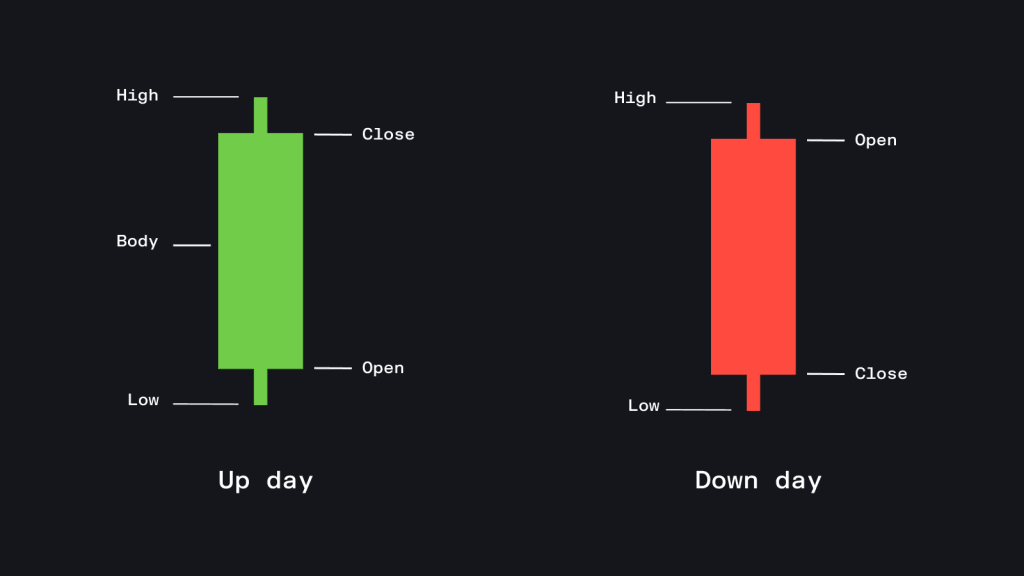
Each candle shows four pieces of information:
- Open — the price at the start of the period
- Close — the price at the end of the period
- High — the highest price reached during the period
- Low — the lowest price reached during the period
The body of the candle is the range between open and close. The thin lines extending above and below are called wicks, and they show the high and low. A green candle means the price closed higher than it opened (buyers were in control). A red candle means it closed lower (sellers were in control).
That’s it at the basic level. A chart is just a sequence of these candles arranged in time, showing you how the price has moved and how buyers and sellers have been behaving.
Timeframes
Every chart has a timeframe, which is the period each candle represents. A 1-hour chart shows one candle per hour. A 1-day chart shows one candle per day.
The timeframe you use depends on how you’re trading. Day traders watch 5-minute and 15-minute charts to catch short-term moves. Swing traders typically use 4-hour or daily charts to identify medium-term trends. Long-term holders look at weekly charts to cut through short-term noise.
As a beginner, start with the daily chart. It smooths out the intraday volatility and gives you a clearer picture of what the asset is actually doing over time.
Trend reading
Before looking at any indicator or pattern, the first question to answer is simple: which direction is the price moving?
An uptrend is a series of higher highs and higher lows. Each peak is higher than the last, and each pullback stays above the previous low. Buyers are consistently in control.
A downtrend is the opposite — lower highs and lower lows. Each rally fails to reach the previous peak, and each pullback goes deeper than the last. Sellers are in control.
A sideways market has no clear direction. Price oscillates between a support level (a floor where buyers step in) and a resistance level (a ceiling where sellers push back). Neither buyers nor sellers are dominant.
Knowing which of these you’re in before placing a trade is basic but genuinely useful. Trading in the direction of the trend is one of the most consistently sound principles in technical analysis.
Support and resistance
Two terms you’ll encounter constantly: support and resistance.
Support is a price level where buying pressure has historically been strong enough to stop a decline and push the price back up. Think of it as a floor. When the price approaches support, traders watch to see if it holds.
Resistance is the opposite. It shows a price level where selling pressure has historically been strong enough to stop a rally and push the price back down. You can think of it as a ceiling.
These levels aren’t magic. They don’t always hold. But they’re where a lot of traders are watching and placing orders, which makes them self-reinforcing to a degree and worth knowing before you enter or exit a position.
Once you’re comfortable reading basic candles and trends, chart patterns are the next step. Formations like the bear flag, dead cat bounce, and golden cross can signal potential price direction and give you more precise entry and exit points. Our Crypto Chart Patterns: A Beginner’s Guide covers the most common ones in detail.
Risk Management
Most people who lose money trading crypto lose it because of poor risk management. Too much in one position, no exit plan, holding through a drawdown they couldn’t afford, or chasing a pump with money they needed.
Risk management isn’t glamorous, but it’s the difference between staying in the game long enough to learn and blowing up your account in the first month.
Only invest what you can afford to lose entirely
This isn’t a cliché. Trading crypto with money you can’t afford to lose creates psychological pressure that leads directly to bad decisions: holding losing positions too long hoping for recovery, panic selling at the bottom, taking oversized positions to make back losses quickly.
The amount you trade with should be genuinely disposable. Not money you’re planning to use for rent, an emergency fund, or anything time-sensitive. If losing it all wouldn’t meaningfully change your life, you’ll make better decisions because you can follow your plan rather than your fear.
Position sizing
Position sizing is how much of your capital you put into a single trade. Most experienced traders risk no more than 1–2% of their total trading capital on any single position. That means if you have $1,000, you risk $10–$20 per trade, not $500.
It sounds overly conservative until you understand the math. At 2% risk per trade, you’d need to lose 50 consecutive trades to wipe out your account. At 20% per trade, five bad trades in a row do it. Losing streaks happen to everyone, so it is position sizing that determines whether a losing streak is just a setback or a catastrophe.
Decide in advance how much you're willing to lose on a trade, set your stop-loss at that level, and size your position accordingly, not the other way around.
Don’t chase pumps
When an asset is up 40% in a day and everyone on social media is talking about it, the urge to jump in is powerful. Almost every time, this is the wrong move.
By the time a price move is visible enough to generate widespread excitement, most of the gain has already happened. The people selling into that excitement are the ones who bought earlier (often much earlier). Buying into a pump means buying from people who are exiting, and late buyers frequently end up holding the bag when the price reverses.
If you missed a move, the right response is to watch and wait for the next opportunity, not to chase the one that’s already happened.
Be (extremely) careful with leverage
Leverage amplifies both gains and losses. At 10x leverage, a 10% move in your favor doubles your money. A 10% move against you triggers a liquidation, and your entire position is wiped out automatically.
Professional traders who use leverage do so with strict risk controls, extensive experience, and an intimate understanding of how quickly things can go wrong. Beginners using leverage skip all of that and go straight to the liquidation part.
The rule is simple: learn spot trading first. Develop a consistent approach, understand how the market moves, and build a track record over months (at least) before considering leverage. There is no shortcut here that works out well.
Have an exit plan before you enter
Before placing any trade, know two things: where you’ll take profit if the trade goes in your favor, and where you’ll cut your loss if it doesn’t. Set these levels before you enter, not after. Once you’re in a position, emotions make rational decision-making harder. The plan you set beforehand is almost always better than the decision you make in the moment.
The specific levels don’t need to be perfect. What matters is having them. A trade with a defined exit is a controlled risk. A trade without one is hope.
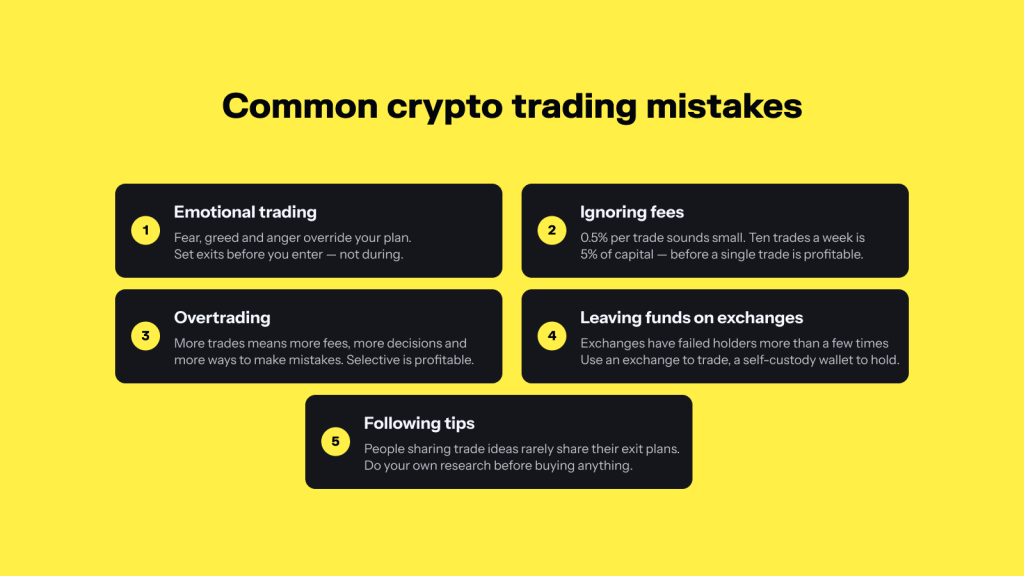
5 Common Mistakes to Avoid When Trading
Most beginner trading mistakes follow predictable patterns. Here are the ones that cost new traders the most money, and how to avoid them.
1. Trading on emotion
The single most common cause of losses in crypto trading isn’t bad analysis. It’s good analysis abandoned the moment the market moves against a position. Fear and greed override rational thinking faster than most people expect, especially when real money is involved.
Fear causes premature exits: selling the moment a position dips, only to watch it recover without you.
Greed causes late entries and overstaying: holding through an obvious reversal because you want more, then giving back all the gains.
FOMO drives the worst version of this: jumping into an asset that’s already pumping, buying from people who are exiting, and holding the bag when the price reverses. If you missed a move, wait for the next one.
Revenge trading is also a huge factor. After a loss, the instinct to immediately make it back by taking a larger or riskier position is powerful and almost always wrong. It turns one manageable loss into a series of compounding ones. When a trade goes wrong, stop, review what happened, and return to your strategy when you’re thinking clearly. The market will be there tomorrow.
The antidote to all of it is the same: have a plan before you enter every trade and follow it. Price targets, stop-losses, position size — set them before you’re in the market, not after.
2. Overtrading
More trades does not mean more profit. Beginners often assume that being active by constantly entering and exiting positions is what trading looks like. In practice, overtrading is expensive in two ways: fees accumulate on every trade, and more decisions mean more opportunities to make mistakes.
The traders who last tend to be selective. They wait for setups they understand, enter with clear intent, and don’t trade out of boredom or the need to feel like they’re doing something. Doing nothing is often the right position.
3. Ignoring fees
Fees compound in ways that beginners routinely underestimate. A 0.5% trading fee sounds trivial, but if you’re making ten trades a week, that’s 5% of your capital per week going to fees before a single trade needs to be profitable.
Fees vary significantly on CEXs, so always compare fee structures. On DEXs, wallets like Solflare show you the fee before you confirm every swap. Factor fees into your profit calculations, not as an afterthought.
4. Leaving funds on exchanges
Using an exchange to trade is fine. Using it as long-term storage is a different and riskier decision. Exchange failures, withdrawal freezes, hacks, and regulatory actions are all documented and real. FTX, Mt. Gox, Celsius, and Voyager are reminders of what happens when a platform fails and customers become creditors.
Once you’re done actively trading a position, move it to a self-custody wallet. The transfer takes minutes, the protection is permanent, and it costs next to nothing on Solana.
5. Skipping research and following tips
Every crypto community has people sharing trade ideas, price targets, and “opportunities.” Some are genuine. Many are people who already hold the asset and benefit from others buying in. Some are just plain manipulation.
Before buying anything, do your own research. Understand what the asset is, why it moves, and what the realistic downside looks like. “Someone on Twitter said it’s going to 10x” is not research. The people sharing that tip are rarely sharing their exit plans.
Where to Go From Here
Trading crypto is a skill. The mechanics can be learned, the mistakes are predictable, and the edge comes from consistency and discipline rather than finding some secret strategy.
Start simple. Pick one exchange or open a Solflare wallet, make your first trade on a liquid asset, and focus on understanding the process before worrying about profit. The goal in your first few weeks isn’t to make money but to learn how the market moves without losing enough to force you out of the game.
If you’re ready to start trading on Solana with full custody of your funds, Solflare is the place to begin.
FAQs
Open an account on a reputable exchange like Coinbase or Kraken, complete identity verification, deposit a small amount you can afford to lose, and make your first spot trade on a liquid asset like BTC, ETH, or SOL. Once comfortable, explore DEX trading directly from a self-custody wallet like Solflare.
Most exchanges and DEXs have no meaningful minimum. Starting with $50–$100 is enough to learn the mechanics without significant risk. What matters more than the amount is that you can afford to lose it entirely.
BTC, ETH, and SOL. All three have deep liquidity, well-documented price history, and abundant public analysis. Avoid low-cap altcoins until you have real trading experience.
It can be, but most beginners lose money early, mostly because of emotional decision-making and poor risk management.
Yes, on a DEX or na self-custody wallet. Trading from a self-custody wallet like Solflare requires no identity verification or account creation. KYC is only required by centralized exchanges.
Spot trading with no leverage, on liquid assets, with defined stop-losses, using only money you can afford to lose. Move funds to a self-custody wallet when not actively trading.
Rarely. Day trading requires strong technical analysis, emotional discipline, and fast decision-making. Swing trading or longer-term spot trading is a far more accessible starting point.
A market order executes immediately at the current price. A limit order lets you set the exact price you want — it only executes if the market reaches that level.
CEXs charge a percentage per trade, typically 0.1–0.5%. On DEXs, fees go to liquidity providers. Solflare shows the exact fee before you confirm any swap. Factor fees into every profit calculation.