

A crypto exchange is a platform where you buy and sell crypto. A crypto wallet is a tool that gives you direct ownership of it. They look similar on the surface but work in fundamentally different ways.
Crypto wallet or an exchange? Even though a CEX is an entry point for most people getting into crypto, here’s why you should also consider a crypto wallet.
This article explains the difference between a centralized exchange and a crypto wallet. What keeping your funds on each actually means, why it matters, and when to use both.
What’s the Difference?
A crypto exchange is a marketplace: a platform where you buy, sell, and trade crypto using fiat currency or other digital assets. Coinbase, Kraken, and Binance are exchanges. They’re where most people enter crypto for the first time. You create an account, verify your identity, deposit money, and start buying.
A crypto wallet is a different tool entirely. It stores your private keys and gives you direct control over your assets on the blockchain. It’s not primarily a trading platform but a whole ownership infrastructure (which is why it is often called a Web3 wallet). Your wallet is what lets you hold, send, stake, and interact with crypto without relying on any company to give you permission.
The two get confused because exchanges provide wallet-like interfaces. You log in, see a balance, send and receive funds. It looks and feels like a wallet. But underneath that interface, something fundamentally different is happening — and understanding what it is changes how you think about crypto.
“Not Your Keys, Not Your Crypto”
This phrase gets repeated constantly in crypto communities, and it exists because the lesson keeps being learned the hard way.
Private keys are the cryptographic proof of ownership on a blockchain. Whoever holds them controls the funds — not the name on the account, not the login credentials, the keys. When you hold crypto on an exchange, the exchange holds your private keys. What you have is an IOU: a number on a screen that represents a claim on funds the exchange is holding on your behalf.
With a self-custody wallet, you hold the keys directly. Transactions are signed on your device. No company stands between you and your funds. You can send, stake, and interact with dApps without asking anyone’s permission — and nobody can freeze your account, limit your withdrawals, or lose your assets in a breach on their end.
The trade-off for that control is responsibility. The exchange handles recovery if you forget your password. With a self-custody wallet, your seed phrase is the only recovery mechanism — if you lose it, nobody can help you. That’s not a flaw in the design. It’s the point.
Learn more: Custodial vs. Non-Custodial Wallet
The FTX lesson
In November 2022, FTX, at the time one of the largest crypto exchanges in the world, collapsed overnight. An estimated $8 billion in customer funds were frozen, and users had no way to access their assets. People who held crypto in self-custody wallets were completely unaffected. People who held crypto on FTX lost access to everything. Some of them permanently.
FTX wasn’t a fluke. Mt. Gox, Celsius, Voyager, BlockFi — the pattern is consistent. When an exchange fails, customers with funds on the platform are creditors, not owners. They join a queue hoping to recover some percentage of what they deposited.
This isn’t an argument against ever using exchanges. They serve a real purpose and most reputable ones are well-run. It’s an argument for understanding exactly what you’re signing up for when you leave crypto on one.
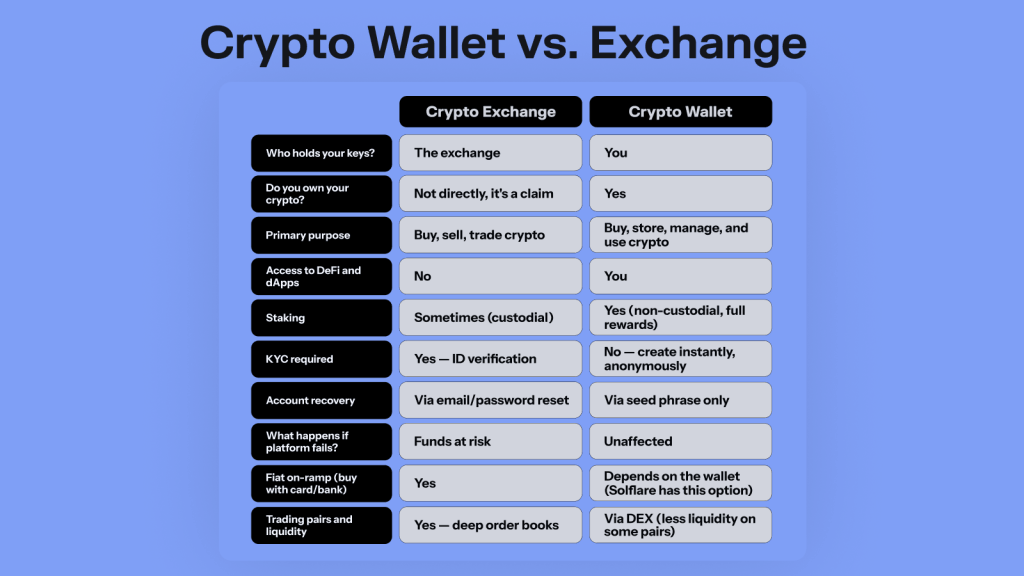
A few things in this table are worth expanding on:
Staking works on both, but differently. Exchange staking is custodial: the exchange stakes on your behalf and takes a significant cut. Coinbase, for example, takes 25–35% of staking rewards. Non-custodial staking through a wallet like Solflare means you delegate directly to a validator, keeping full custody and paying only the validator’s commission (typically 3–7%).
Account recovery is a fundamental difference. If you forget your exchange password, you reset it via email. If you lose access to your self-custody wallet, your seed phrase is the only recovery mechanism. That responsibility is the trade-off for true ownership.
Fiat access is the one area where exchanges have traditionally had a clear advantage. Buying crypto with a bank transfer or credit card requires a fiat on-ramp, and many self-custody wallets don’t provide one.
Solflare does — you can buy SOL and other assets directly in the app via integrated onramp providers, without going through a centralized exchange first.
When to Use an Exchange
Exchanges exist for good reasons, and there are situations where they’re genuinely the right tool. Here’s when using one makes sense.
Buying crypto with fiat
This is the primary use case for most people entering crypto. You have dollars, euros, or another fiat currency and you want to convert them into SOL, BTC, or another digital asset. Exchanges handle this well — they connect to banking infrastructure, accept card payments, and process fiat-to-crypto conversions at competitive rates. For most people, the flow is: buy on an exchange, then move funds to a wallet once you’re ready to hold or use them.
Active trading
If you’re trading frequently — using limit orders, responding to market movements, or running high volume — a centralized exchange is built for that. Deep liquidity, tight spreads, fast execution, and a full suite of order types are what CEXs do well.
For most everyday swaps and moderate trading, a DEX via your wallet is equally capable. On Solana, Jupiter aggregates liquidity across the ecosystem and handles most pairs at competitive rates. A CEX makes the most sense at the high-frequency or high-volume end.
Converting back to fiat
When you want to convert crypto back to your bank account, you need an exchange. Self–custody wallets hold crypto — they don’t connect to the traditional banking system for withdrawals. An exchange is the off-ramp.
Getting started for the first time
For complete beginners, an exchange can be a lower-friction entry point. The interface is familiar — it looks more like an online bank than a blockchain tool. Customer support is available. The learning curve is gentler.
That said, the goal for most users should be to move to self-custody once they’re comfortable. An exchange is a reasonable starting point, not a permanent home for your assets.
When to Use a Wallet
A self-custody wallet is the right tool for anyone who wants to actually use crypto, not just hold a number on someone else’s screen.
Holding crypto long-term
If you’re buying and holding SOL or other assets with a medium- or long-term view, a self-custody wallet is the safer place to keep them. Your funds aren’t exposed to exchange risk, platform failures, or withdrawal restrictions. They’re on the blockchain, under your control, accessible whenever you need them.
The longer your holding period, the stronger the argument for self-custody. Time on an exchange is time your funds are exposed to counterparty risk you don’t need to take.
Staking and earning yield
Non-custodial staking through a wallet like Solflare gives you significantly better returns than exchange staking. You delegate directly to a validator and keep full custody throughout. No platform is taking 25–35% of your rewards off the top.
On Solana, staking currently yields 5.5–8% APY, compounding automatically each epoch. That yield is yours in full when you stake through a wallet.
Learn more: Is Staking Solana Worth It?
Accessing DeFi, dApps, and NFTs
DeFi protocols, NFT marketplaces, decentralized exchanges, staking platforms, gaming apps — none of these are accessible from a centralized exchange account. They require a self-custody wallet that connects directly to the blockchain.
If you want to use any part of Solana’s ecosystem beyond basic token holding, a wallet is not optional. It’s the entry point. Solflare connects to the full Solana ecosystem directly from the app — DeFi, NFTs, swaps, and staking in one place. [INTERNAL LINK: Crypto 101 – What Is DeFi]
Full ownership and control
This is the underlying reason for all of the above. A self-custody wallet means your crypto is genuinely yours: not a claim on a platform’s balance sheet, not subject to anyone else’s rules or decisions. You can send it anywhere, use it however you want, at any time, without asking permission.
That’s what crypto was designed to enable. A wallet is how you actually get there.
Choosing a Self-Custody Wallet for Solana
If you’ve decided self-custody is the right move, or you’re ready to move funds off an exchange, the next question is which wallet to use. For Solana, a few criteria matter most.
Blockchain-specific vs. multi-chain
Let’s take Solana for example. A wallet built specifically for Solana will give you better token support, more reliable dApp connectivity, and a more complete feature set than one that added Solana alongside twenty other chains. If Solana is your primary focus, a dedicated wallet is the stronger choice.
Non-custodial by design
This should be the baseline. Some wallets marketed as “self-custody” still have recovery mechanisms or key management systems that introduce a third party. Look for a wallet where your keys are generated locally and never leave your device.
Security features built in
Transaction simulation, suspicious token flagging, and clear transaction warnings are some of the basic security features a well-built wallet should include by default.
Hardware wallet support
If you’re moving meaningful holdings off an exchange, you’re stepping up your security posture. A wallet with native hardware wallet support lets you go further — keeping your private keys fully offline while using the same interface for everything else.
Support when you need it
Self-custody means you’re responsible. But having access to knowledgeable support when something is unclear is worth factoring in. Not all wallets offer this.
For Solana, Solflare covers all of these. It’s built exclusively for Solana, fully non-custodial, includes transaction simulation and token flagging, supports hardware wallet security via Solflare Shield, and offers 24/7 live human support. If you’re moving funds off an exchange and looking for a place to hold your crypto long-term, it’s the natural starting point.
FAQs
A crypto exchange is a platform where you buy and sell crypto. A crypto wallet gives you direct ownership of it. On an exchange, the platform holds your private keys. In a self-custody wallet, you do.
Reputable exchanges have strong security, but holding crypto on one always carries counterparty risk. If the platform freezes withdrawals, gets hacked, or fails — as FTX, Mt. Gox, and Celsius did — your funds are at risk. For long-term holdings, a self-custody wallet removes that risk entirely.
For buying and selling, no. But if you want to stake, use DeFi, hold NFTs, or simply own your crypto outright, yes. An exchange account and a self-custody wallet serve different purposes — most serious crypto users end up using both.
You become a creditor, not an owner. You join a queue hoping to recover some percentage of your funds. Crypto held in a self-custody wallet is completely unaffected by what happens to any exchange.
Not if you’re careful. Verify the receiving address before confirming, make sure the network matches the asset you’re sending, and send a small test amount first if it’s your first transfer.
Custodial means a company holds your private keys on your behalf — like an exchange. Non-custodial means you hold them yourself — like a self-custody wallet. The distinction determines who actually controls your funds.
Yes, but exchange staking is custodial and expensive. Platforms like Coinbase take 25–35% of your rewards. Non-custodial staking through a wallet like Solflare means you keep everything minus a small validator commission of 3–7%.
No. Creating a self-custody wallet requires no identity verification, no email, and no personal information. KYC is only required by centralized exchanges.


